Census 2027: How To Do Enumeration Online
Updated: 13-05-2026 at 3:30 PM


1k
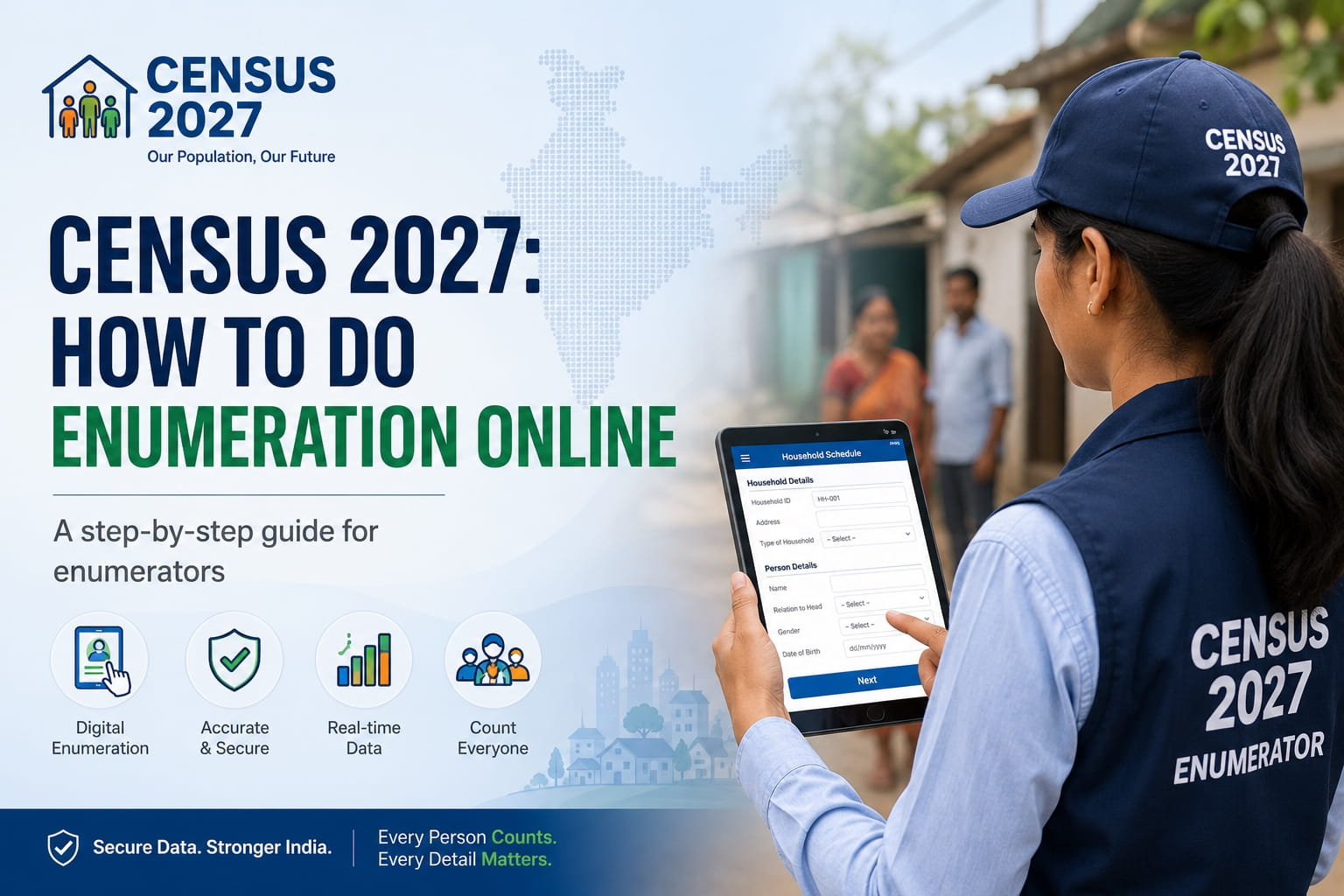



India is the most populous country in the world, which makes collecting information about its citizens. i.e., the census is a significant responsibility of the government. Census is ideally to be done in the gap of every ten years. The last census was conducted back in the year 2011, which moves the next census to happen in the year 2021. However, due to the major outbreak of the COVID-19 pandemic, the 2021 census was put on hold till the situation was resolved and everyone was immunised against the virus.
Now that everyone is safe and sound and the situation is under control, the government of India has announced the Census 2027. India is on the pathway of transitioning from the traditional paper-based system to the digital system, and one of the things that was recently introduced by the government in line with this same aim is the self-enumeration service. The census 2027 will be conducted via the self-enumeration service through which people can submit their own personal and household-related details with the help of an online portal.
Read More On Top 10 Documents That Every Indian Citizen Must Have!
Read the article to learn the complete details of the self-enumeration registration India, ranging from its meaning and benefits to documents required, including answers to questions, like ‘how to do self-enumeration online?’.
Self-Enumeration Service Overview
The table below summarises key details about the process of self-enumeration registration India that one should know.
| Name of the service | Self Enumeration Service |
|---|---|
| Meaning | A digitised service through which people can submit their personal and household-related information. |
| Introduced for | Census 2027. |
| Objective | To make the process of data collection faster, more efficient, and time and cost-saving. |
| Mode of self-enumeration | Online self-enumeration process. |
Self-Enumeration Meaning And Process Explained
Self-enumeration is the process of providing personal details to official organisations for various purposes, such as census, surveys, and verification. Unlike the traditional process, self-enumeration is a digital process in which people fill in their own details in the form and submit it, along with supporting documents, via an online portal. The government has designed this process to make the data collection for census purposes easy and convenient for both the people and the authorities.
The census for the year 2027 via self-enumeration is being done in two phases; the first phase is about the housing census, and the second is about the population, so that the government can have comprehensive data about both the present housing conditions and the total number of citizens living across various parts of the nation.
Self-Enumeration Service Benefits And Eligibility
The self-enumeration service designed for the census 2027 comes with numerous benefits for the people of India. Some of its major and popular benefits are described below in detailed points:
-
One of the most popular advantages of the self-enumeration service is the mode through which this service is being made accessible to the people. Unlike traditional forms of data collection wherein officials travelled from one household to another for collecting data about their families and houses, self-enumeration can be done by people themselves in just a couple of minutes from the comfort of their respective homes.
-
As the process of self-enumeration is completely digitised, it not only makes the process of census convenient for both the citizens and the authorities, but also speeds up the entire process from months to days.
-
In the olden days, the census happened via the traditional method, which is prone to manual errors, like incorrect filing of information, spelling errors, etc. The online self-enumeration service will reduce these errors to a considerable extent as people will themselves fill in their personal information via the online portal.
-
Census is an extremely expensive process as the government has to organise various things, like hiring of enumerators, training of the enumerators, transportation, data entry, etc. Self-enumeration is an online process that reduces these expenses to a great extent. This is not only cost-effective but also reduces the govt’s dependency on the paper-based method of storing data.
-
Since the entire process of self-enumeration is digitised, it would be very efficient, convenient, and secure for the govt authorities to organise and manage data of the current Indian population.
Eligibility
Every household and every citizen of India is required to do the self enumeration service without fail.
Also Read On Voter ID - Election (EPIC) Card Detail Guide
How To Fill The Self-Enumeration Form Online Step By Step?
Individuals can fill in the self-enumeration form through an online platform, accessible from the comfort of their homes. The self-enumeration portal registration process 2026 is broken down below in a stepwise manner for one’s better understanding and clarity:
Step 1: Please visit the official digital self enumeration portal created for the census.
Step 2: On the homepage of the site, you will be required to select your state or Union Territory (UT). Select the correct state and click on ‘Verify & Proceed’. The portal will also ask you to select the language you are comfortable with. This option has been created to provide as much ease to the people of India as possible when accessing the online portal.
Step 3: For self-enumeration login, the system will ask you certain personal details, such as the name of the head of your family, mobile number, and email ID. Validate using the One-time Password (OTP) that will be sent to your mobile number.
Step 4: After successfully logging in to the portal, individuals will be required to fill in the details in the self-enumeration form. The form is divided into three sections that are described below:
-
Section A: This section is dedicated to ‘Census House’, meaning any house that has a separate entrance. You will be required to fill in details, like the material of the floor, wall, and roof of the house, and details about the present condition of the house.
-
Section B: Section B is about the details of the people living in one particular house, such as the total number of residents, name and gender of the head of the house, and the social category of the whole family (General, Scheduled Caste, Scheduled Tribe, or others). This section will also have questions concerning the legal owner of the house, the number of rooms in the house, information about married residents, etc.
-
Section C: This section focuses on the amenities equipped in the house, such as the source of drinking water, the source of lighting, sanitation facilities, a wastewater drainage mechanism, bathing facilities, kitchen facilities, the type of fuel used for cooking, etc.
-
Section D: The last section of the form is concerning the assets in the house owned by the family, like a television set, a radio, internet facilities, a laptop or computers, mobile devices, etc. One would also be required to submit their vehicle-related details.
Step 5: Upload the scanned copies of all the documents required in the correct size and format.
Step 6: Recheck the information entered in the form and ensure they are all accurate and correct. After thorough checking, click on ‘Submit’ to complete the self enumeration service India apply online process.
After the successful submission of self-enumeration, the system will show a confirmation message on the screen of your device. Note down the Self-Enumeration ID (SE ID) and keep it safe for future reference.
What Are The Documents Required For Self Enumeration Service?
Applicants need to attach some supporting documents while doing the self-enumeration registration India. The list of required documents is as follows:
- Proof of identity. Acceptable forms of ID are Aadhaar card, PAN card, Voter ID card, Passport, Driving License, Ration Card, or a Domicile Certificate.
Read More On NPCI-Aadhaar Linking Online: Step-By-Step Guide 2026
Conclusion
The Self Enumeration Service is one of the most advanced steps taken by the government of India in the context of census operations in the country. Some aspects of the process of data collection for the census are now being digitised not only for the convenience of people and the authorities, but also to make the process efficient and time and resource-saving.
The authorities have done their part, but the success of this self-enumeration service for the census lies in our hands. i.e., we, the citizens of India. We request that you complete the self-enumeration service as soon as possible and make sure to fill in the correct information only, as this data collection is extremely important. If done carefully, the newly introduced self-enumeration service can bring wonders for the future of the country, its people, and, of course, the next census.
Stay updated with Jaagruk Bharat to get the latest information on government schemes and more, and reach out to us via our community page if you have any questions.
Why Choose Jaagruk Bharat For Self-Enumeration?
Allow Jaagruk Bharat to help you and complete self-enumeration on your behalf in just a few clicks! Get 24/7 support, expert assistance, online services, and a hassle-free application Process with Jaagruk Bharat.
Frequently Asked Questions
0

0
1k
0
0
1k Views
0

No comments available