CKYC vs eKYC: Key Differences Explained (2026 Guide)
Updated: 11-04-2026 at 12:30 PM


2k
In today’s digital financial system, one of the most important components is the verification of one’s identity, which is extremely crucial to maintain the sanctity of the systems, to increase the safety and security of people’s sensitive information, and to create strong barriers against various kinds of criminal activities, like fraud. National-level bodies such as the Central Registry of Securitisation, Asset Reconstruction, and Security Interest of India, and the Unique Identification Authority of India have introduced several verification mechanisms, like CKYC and eKYC.
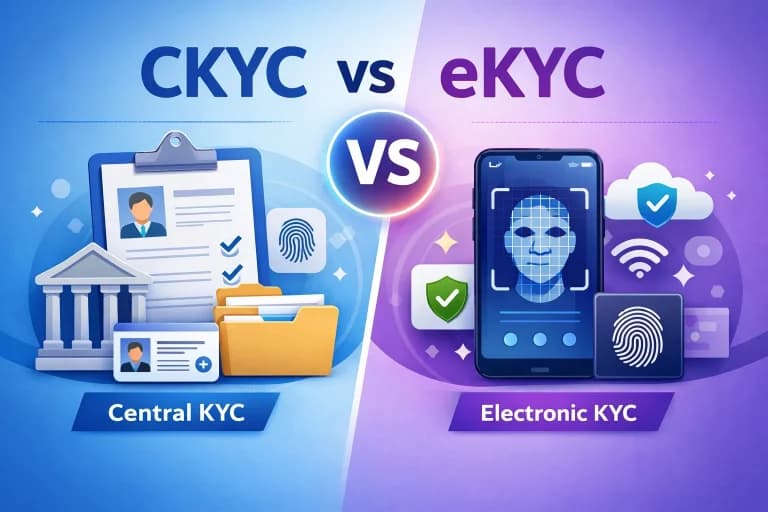
Central Know Your Customer and Electronic Know Your Customer are both verification procedures; however, different when it comes to the details of each of the processes. CKYC maintains a central registry wherein the KYC is done only once; on the other hand, eKYC is done multiple times whenever one visits a financial institution to avail a service.
Read the article to learn more about the specifics of the differences between CKYC and eKYC, ranging from their meaning and types to benefits and exact points of difference.
Read More on IRDAI Issues New KYC Requirement Norms For Policyholders
CKYC Vs eKYC Overview
The table below summarises key details of the differences between CKYC and eKYC that one should know about.
| What is CKYC? | Central Know Your Customer stores people’s data in a single central registry. |
|---|---|
| What is eKYC? | Electronic Know Your Customer is a digital method of verifying one’s identity. |
| Regulatory bodies | CKYC is under the Central Registry of Securitisation, Asset Reconstruction, and Security Interest of India, and eKYC is under the purview of the Unique Identification Authority of India. |
| Purpose | CKYC aims to verify people’s identity only once, but eKYC requires multiple verification checks to be done every time an individual goes to a financial institution to avail of a new service. |
| Which one is faster? | eKYC is faster compared to CKYC |
| Types of CKYC | Normal, simplified, small, and KIN-based |
| Types of eKYC | OTP-based, biometric-based, video KYC, and offline KYC. |
What Is CKYC?
Central Know Your Customer (CKYC) is a centralised system introduced by the Central Registry of Securitisation Asset Reconstruction and Security Interest of India (CERSAI) under the guidelines given by the Reserve Bank of India (RBI). The main aim of the creation of CKYC was to create a unified system of verification that would be valid for all types of institutions, like banks, insurance companies, etc., whether public or private.
The process of doing CKYC registration is also extremely simplified by the authorities. All people are required to do is visit a financial institution, submit the necessary supporting documents, which will be uploaded to a central registry by the authorities, and after successful registration, the applicant will be provided with a 14-digit CKYC number. The number can then be used across various financial institutions, like mutual funds, stockbrokers, pension platforms, and others, to enjoy the services provided by them.
What Is eKYC?
eKYC stands for electronic Know Your Customer. As the name suggests, it is a digitised process wherein one’s information and records are verified using their digital data stored in databases maintained by the Unique Identification Authority of India (UIDAI). As the process is completely digitised. Individuals are required to carry out Aadhaar-based authentication through the various methods offered by the UIDAI for people’s convenience.
eKYC is a speedy process of verification; however, it needs to be done every time an individual visits a financial institution for whatever service they might need at the time, such as opening an account, purchasing a SIM card, investing in an insurance policy, or a mutual fund, etc. and that is essentially one of the problems of this type of verification as well, the fact that it needs to be done every single time.
Also Read: Have You Completed Your Ration Card e-KYC?
KYC Types In India
When it comes to types of Know Your Customer, either electronic or central, the types just mean methods of verification offered by the regulatory authorities. All verification methods offered under CKYC and eKYC are described in detail below for one’s reference.
Types Of eKYC
The Unique Identification Authority of India offers 4 major ways through which people can complete the verification of their identities. All four ways are as follows:
| Method of verification | Description |
|---|---|
| Aadhaar OTP-based eKYC | This is the most common method of completing the eKYC procedure, wherein a One-Time Password (OTP) is sent to the mobile number linked with one’s Aadhaar card number. Individuals doing eKYC through this method are required to fill in their Aadhaar-related details, and then an OTP is received on the linked phone number. It is a quick method of verification, however, comparatively less secure. |
| Aadhaar Biometric-based eKYC | Here, identity verification of an individual is done using biometric data, like fingerprints or an iris scan. The collected biometric data is then matched with the information mentioned in one’s Aadhaar card. Comparatively, this method is much more secure as everyone’s biometrics are unique. |
| Video-based eKYC | Video Customer Identification Process (V-CIP) is an advanced method of verification approved by the apex bank of India. i.e., the Reserve Bank of India (RBI). Under this process, a live video interaction takes place between the individual who wants to get the verification done and the verification official, wherein the individual is required to show the original documents, and a facial recognition check is performed. This method of verification reduces the instances of impersonation. |
| Offline eKYC | Here, people are required to share their identity-related details. i.e., details mentioned in their Aadhaar, but the verification does not happen in real-time, like in other methods of verification. |
Read More on Free Aadhaar Update: UIDAI Extends Free Aadhaar Update Deadline, Check New Dates, Steps, And more t
Types Of CKYC
Unlike eKYC, here the methods mean the classification of KYC records based on the level of verification done by the Central Registry of Securitisation Asset Reconstruction and Security Interest of India. There are four types of classification mentioned below in brief for one’s reference:
| Type of account | Description |
|---|---|
| Normal CKYC Account | A normal CKYC account is created when an individual submits all the documents, like proof of identity, proof of address, and a photograph. After the submission of details, the authorities conduct a thorough verification check, and hence, it is considered one of the most reliable forms of CKYC. |
| Simplified CKYC Account | This type of account is created for people who are categorised as low-risk customers who may not have all the required documents. Such people can complete the central verification procedure, but their account still comes with certain restrictions on transaction limits until they do normal KYC. This has been created by the authorities for people from backward backgrounds who don’t know the importance of keeping all the documents intact and safe. |
| Small CKYC Account | A small CKYC account is opened with minimal documents, often just using a self-declaration and some basic personal details. People can do this type of verification and access basic banking-related services, but with strict limits set on deposits and withdrawals. |
| KYC Identifier-based Account | Under this type, a person’s KYC Identification Number (KIN) is used to get details from the CKYC registry. So here, individuals don’t have to conduct the CKYC process by submitting details again; their already present information in the system is used to verify their details again. This is the most efficient way of completing the verification check. |
Also Read: Five-Year-Old FASTags To Be Replaced, Re-KYC Needed After 3 Years
Benefits Of KYC
The Central Know Your Customer and Electronic Know Your Customer come along with various benefits. The benefits of both verification procedures are laid out below for one’s better understanding:
CKYC Benefits
-
One of the major benefits of doing the Central KYC verification process is that it only needs to be done once and not multiple times. Once an individual completes the CKYC process and gets a KYC Identification Number, that one number can be used by various financial institutions to verify an individual’s identity. This not only reduces paperwork but also saves the time of both the people and the officials working in financial institutions.
-
Central Know Your Customer is a strong measure against various kinds of criminal activities as all of people’s sensitive data is stored in one place and not scattered. The digital system is also created using various protective layers to reduce instances of identity fraud, duplication, and misuse of people’s documents for personal gain by potential criminals.
-
People’s information under the CKYC system is stored in a central registry, which can be used by various financial institutions to verify their identity. This reduces inconsistencies in data and minimises instances of errors.
eKYC Benefits
-
One of the most popular advantages of the Electronic Know Your Customer verification process is the speed. eKYC can be done by people in a couple of minutes using OTP or biometric-based Aadhaar authentication, which makes it instant and comparatively much faster than other processes, like CKYC.
-
As the process of eKYC is digital, there is no need for people to visit governemnt offices, fill the application form manually, or submit documents in traditional paper copies. This minimises the risk of losing or damaging the documents or the forgery of documents.
-
The process of eKYC reduces the operational and administrative costs to be paid by the financial institutions by eliminating manual verification and storage-related expenses. Digital process needs minimum hiring as everything is done by software in just a couple of seconds.
Also Read On Annual e-KYC Mandatory For LPG Subsidy In India 2026: What You Must Know
What Is The Difference Between CKYC And eKYC?
There are several differences that make CKYC different from eKYC. The exact differing points are described below in a tabular format for one’s ease of understanding:
| Component | CKYC | eKYC |
|---|---|---|
| Full form | Central Know Your Customer. | electronic Know Your Customer. |
| Regulatory body | Central Registry of Securitisation Asset Reconstruction and Security Interest of India (CERSAI). | Unique Identification Authority of India (UIDAI). |
| Purpose | To create a unified system of verification that would be valid for all types of institutions, like banks, insurance companies, etc., whether public or private. | To instantly verify a person’s identity digitally for a specific service. |
| Any unique number generated? | Yes, a 14-digit KIN (KYC Identification Number) is generated. | No unique number is generated. |
| Modes of verification | Can be physical or digital. | Completely digital. |
| Methods of verification | Document-based verification method, wherein data is stored in a central registry system. | Aadhaar-based OTP or biometric authentication as a method of verification. |
| Required documents | PAN card, Aadhaar card, proof of address, photographs, etc. | Only Aadhaar is enough. |
| Implementation agencies | Implemented at a regulatory level and overseen by national regulatory authorities | Implemented by individual service providers, like banks, insurance companies, and telecom operators. |
| Speed of processing | Comparatively slower (may take some days) | Very quick (done in a couple of minutes) |
Read More on MP Samagra E-KYC Portal 2026- Integrated Gateway To Government Services In Madhya Pradesh
Conclusion
Both CKYC and eKYC verification processes are not opposites but processes that complement each other and share the same aim, and that is to make the Know Your Customer identity verification process safer and more secure. The Central KYC procedure provides one-time verification only, which enhances convenience, while on the other hand, the electronic Central Know Your Customer completes the verification in a couple of minutes, but it needs to be done every single time one visits a financial institution to avail of a new service.
Both of the verification procedures show how India is working on fulfilling the Digital Bharat mission and how carefully the authorities are focusing on strengthening the security aspect of it, as nothing is more important than that. Overall, both processes might seem similar, but when looked upon carefully, one can understand the beauty of the specifics each process holds.
To comply with the verification measures, one needs to understand both the process carefully to make an informed decision about which type of verification they would like to do to comply with the laws, and to access the services provided by various financial institutions without any problems.
Stay updated with Jaagruk Bharat to get the latest information on government schemes and more, and reach out to us via our community page if you have any questions.
Why Choose Jaagruk Bharat To Apply For CKYC?
Allow Jaagruk Bharat to help you in applying for CKYC on your behalf in just a few clicks! Get 24/7 support, expert assistance, online services, and a hassle-free application Process with Jaagruk Bharat.
Frequently Asked Questions
0

1
2k
0
1
2k Views
0

Mukesh
|
29 March 2026
Ckyc
0