Disability Percentage: How Fair Is The Benchmark System?
Updated: 19-05-2026 at 12:30 PM


1k
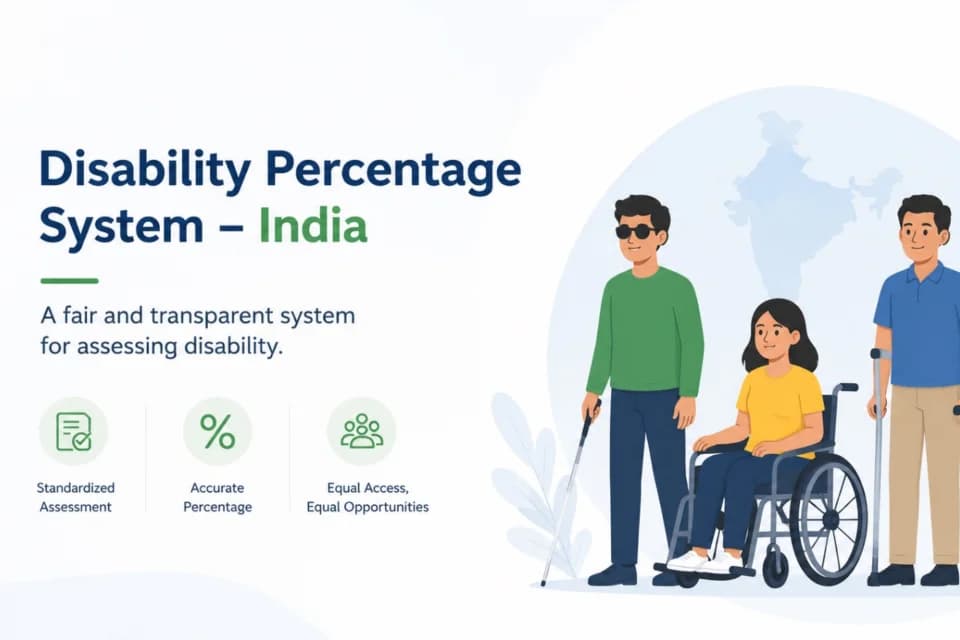
The governing law of the rights of Persons with Disabilities (PwDs) has undergone a series of changes, dating back to the year 1995, when the Persons with Disabilities (Equal Opportunities, Protection of Rights and Full Participation) Act was introduced. Today, the rights of PwDs are governed by one law. i.e., the Rights of Persons with Disabilities Act of 2016. There are several provisions in the law, and one of the provisions is concerning the disability certificate percentage rules India.
As of now, the disability certification heavily depends upon one thing, and that is crossing through the benchmark disability of 40%, which is not an ideal measure of deciding who should come under ‘Persons with Disabilities’ and who should not.
Read the article to learn the complete details of the disability percentage system, ranging from its meaning and benefits to the reasons why it is a flawed system that should be reformed.
Read More On National Action Plan For Skill Development Of Persons With Disabilities
Disability Percentage Overview
The table below summarises key details about the disability percentage and the debate surrounding it.
| Benchmark Disability meaning India | Individuals who have a minimum of 40% disability or more. |
|---|---|
| Governing law | Rights of Persons with Disabilities Act of 2016. |
| Total number of recognised disabilities under the act | 21 disabilities. |
| How much disability required for govt benefits? | Minimum 40%. |
| Purpose of disability certification | Enables persons with disabilities to reap a range of government-provided benefits, like a reservation quota. |
| Criticism of the benchmark disability system | Heavily criticised as a simple percentage cannot reflect the suffering and struggles of persons with disabilities. |
| Need for reform | A holistic assessment should be created, assessing the subjective experiences of PwDs as well. |
Benchmark Disability Meaning India
As per Section 2(r) of the Rights of Persons with Disabilities Act (RPwD) of 2016, a ‘person with benchmark disability’ refers to those individuals who have a minimum of 40% disability or more. This automatically means that a person with a disability is required to undergo a thorough medical checkup by a competent medical authority (usually from the government sector) to determine the percentage of disability experienced by the person.
The threshold. i.e., a minimum of 40% is extremely important as it is the main deciding factor that qualifies a person to come under the official ‘Persons with Disabilities’ category. If the threshold is met, a person can access a range of benefits provided by the government of India to people with disabilities, such as reservations across various sectors, scholarships, concessions on assistive devices, and eligibility for various social welfare schemes by the central or state government authorities.
Disabilities Recognised Under The RPwD Act
One must know what all disabilities are covered under the RPwD Act. The list of disabilities recognised under the legal framework is as follows:
-
Visual impairment (complete loss or low vision).
-
Leprosy-cured persons (cured but still face significant impairments).
-
Hearing impairment (deaf and hard of hearing).
-
Locomotor disability (of joints, bones, muscles).
-
Dwarfism.
-
Intellectual disability.
-
Mental illness.
-
Autism Spectrum Disorder.
-
Cerebral Palsy.
-
Parkinson's disease.
-
Specific Learning Disabilities.
-
Multiple Sclerosis.
-
Muscular dystrophy and blood diseases, like Thalassemia.
-
Acid attack victims.
Disability Certificate Percentage Rules India
The disability system is governed by the Rights of Persons with Disabilities Act in India. Some of the most important disability certificate percentage rules India are described below in detailed points for one’s reference:
-
An individual should have at least a minimum of 40% benchmark disability or more than that to qualify for a disability certificate in India. Individuals who meet or exceed this minimum percentage value can access a range of benefits, all created with the aim of making lives easier for persons with disabilities.
-
The disability certificate percentage rules India clearly state that the percentage of disability should be assessed by government-authorised medical boards and medical professionals.
-
The percentage of disabilities is to be calculated using different methods of calculation based on the exact type or kind of disability one has. There are different calculation methods for physical disabilities, intellectual disability, hearing impairment, mental illness, and others.
The above-mentioned rules are just a gist of some of the key disability certificate percentage rules India.
Also Read On Top 10 Government Schemes For Disabled Persons In India
Disability Percentage Criteria India Benefits
The benchmark disability system provides persons with disabilities with numerous benefits, some of which are mentioned below in brief for one’s better understanding:
-
People who have a benchmark disability or more than that are provided with a valid disability certificate, with the help of which they can access reservation quotas for various services across various sectors, like education or employment in the public sector.
-
One of the disability percentage criteria India benefits is access to various forms of financial aid, like pensions, maintenance allowances, scholarships, etc. These are given to PwDs to ensure that they don’t miss any opportunity due to their limitation or due to monetary constraints.
-
Persons with Disabilities can also enjoy travel concessions when travelling in public transportation, like buses and trains. This provision is made by the government to make the travel experiences of Persons with Disabilities as convenient and not financially burdening as possible.
-
Another one of the most important disability percentage criteria India benefits is heavy subsidies on assistive devices, like wheelchairs, hearing aids, artificial limbs, etc. These are heavily subsidised by the government so that Persons with Disabilities, irrespective of their economic backgrounds, can possess the needed assistive device.
Does this mean the benchmark disability system is completely fair and good? Just like a coin has two sides, allow us to shed light on the other side of the coin as well.
Is The 40% Threshold For Determining Disability Fair?
We will get to the answer to this question with your help, the reader. Imagine an unpleasant scenario wherein, unfortunately, you are experiencing some form of disability that is hindering with almost all aspects of your personal and professional life. You visit the relevant govt office to apply for and obtain a disability certificate, and they request you to set an appointment with a medical officer who can then determine the percentage of your disability. The results come, and you have a disability percentage of 39%.
Now, let us ask you the previous question again: Do you think the 40% threshold is fair? Do you think we can put a number on someone’s struggles and daily suffering?
The benchmark system might seem like the most logical route taken by the government, essentially to create a barrier so that no one can misuse the benefits; however, in reality, the benchmark system is trying to quantify a completely subjective phenomenon that varies from person to person and from environment to environment (both physical and psychological).
Medical Model Vs Social Model Of Disability
The essence of this debate around the disability percentage is linked to some important theoretical approaches.
India depends upon the medical model of disability that views disability as an impairment of a body part of a person. Here, medical professionals assess one’s disability, meaning limitations, and because there is no cure for their problems, they assign a percentage to their limitations. This model seems to ensure fairness and objectivity, but objectivity cannot be the central factor in something that is mostly subjective.
With changing times, people are advocating for the adoption of the social model of disability, which says that disability is not just a limitation of a body part that is not functioning, but it is about the societal barriers, such as inaccessible infrastructure, discriminatory practices, prejudicial attitudes, limited access to assistive devices, etc., faced by people due to their disabilities and impairments.
The model also draws people’s attention to the fact that the Rights of Persons with Disabilities Act is itself not in agreement with the medical model, but it has elements of the social model that focus upon inclusion of persons with disabilities and initiatives to make them feel empowered and as independent as possible.
Is This Implying That the Benchmark Disability Should Be Renounced?
In one word, no. We are in no way implying that the entire benchmark disability system should be removed or renounced by the government of India.
In contrast, we are implying that the benchmark disability system should not be the sole criterion for determining who gets to receive the govt’s help and who should be excluded because an ambiguous percentage decided they are not suffering enough.
The government of India is working exceptionally for the welfare of people from all classes and backgrounds. But the policies are not perfect and are always open to change with changing times. The deciding criteria of disability should not just be the minimum percentage criteria, but rather it should be a wise combination of various types of assessments, specifically assessments created to capture subjective experiences of people.
Read More On Viklang Pension Yojana- Eligibility, Benefits, Application Process & Pension Amount
Conclusion
There is no doubt about the fact that the government of India has introduced and is still working on introducing various social welfare schemes and beneficial services, like financial aids, reservation quotas, and many others, to make the lives of Persons with Disabilities as normal and comfortable as possible.
However, the benchmark disability system is far from any form of fairness in the determination of who should be considered a PwD and who should not be. Any form of disability can never be just determined using a quantitative approach, as disabilities and illnesses might share the same name, but the experiences of the people are always drastically different from one another.
The government of India needs to add more things to this existing benchmark disability criteria and add holistic assessment measures, taking into account the subjective experiences of people as well.
Stay updated with Jaagruk Bharat to get the latest information on government schemes and more, and reach out to us via our community page if you have any questions.
How To Apply For A UDID Card Via Jaagruk Bharat?
Allow Jaagruk Bharat to help you and apply for a UDID card on your behalf in just a few clicks! Get 24/7 support, expert assistance, online services, and a hassle-free application Process with Jaagruk Bharat.
Frequently Asked Questions
0

0
1k
0
0
1k Views
11

No comments available