One Aadhaar One Udyam: New Rule For MSME Registration Explained (2026)
Updated: 16-04-2026 at 3:30 PM


2k
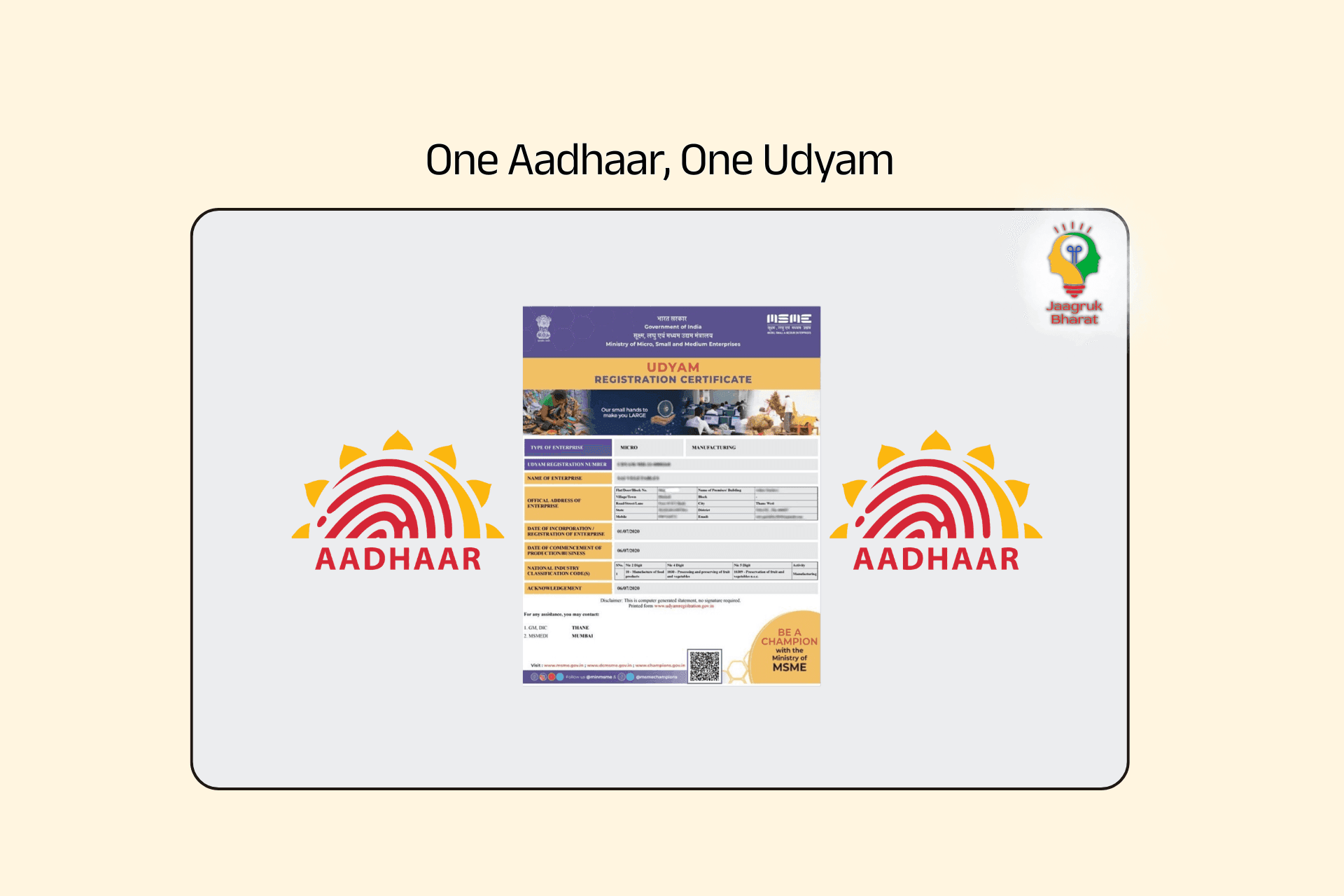
India’s Micro, Small, and Medium Enterprises (MSME) sector is one of the strongest pillars of the country’s economy, contributing significantly to employment generation, industrial output, and exports. According to recent government estimates, MSMEs contribute nearly 30% to India’s GDP and around 45% of total exports, making them a crucial driver of economic growth and self-reliance.
To strengthen this sector and bring more transparency into business registration systems, the Government of India introduced the concept of “One Aadhaar, One Udyam”, also widely searched as one aadhaar one udyam meaning. This rule is part of a broader digital governance initiative aimed at simplifying compliance, reducing duplication, and ensuring that government benefits reach genuine businesses.
Earlier, under previous systems like Udyog Aadhar registration, it was possible for individuals to create multiple MSME registrations using the same Aadhaar number, which often led to misuse of subsidies and duplication of records. With the introduction of Udyam registration and its integration with Aadhaar, PAN, and GST databases, the government has created a more structured and reliable system.
The One Aadhaar, One Udyam rule ensures that each entrepreneur has only one MSME registration, under which multiple business activities can be declared. This has significantly improved the MSME registration online system by making it more transparent and efficient.
One Aadhaar, One Udyam — Overview
The table below highlights the key insights of the One Aadhaar, One Udyam:-
| Particular | Details |
|---|---|
| Policy Name | One Aadhaar, One Udyam |
| Introduced By | Ministry of MSME |
| Applicable To | All MSMEs in India |
| Registration System | Udyam Registration Portal |
| Key Rule | One Aadhaar = One MSME Registration |
| Mode | Fully Online |
| Registration Fee | Free |
| Validity | Lifetime (No renewal required) |
| Database Integration | Aadhaar, PAN, GST |
| MSMEs Registered | 1+ Crore |
Also Read: Boosting MSMEs: Get ₹20 Lakh Via Mudra Loans Initiative
What Is “One Aadhaar, One Udyam”?
The One Aadhaar, One Udyam rule is a government regulation that ensures that a single Aadhaar number can be used to obtain only one MSME registration through Aadhaar-based Udyam registration. This policy ensures a clean and transparent database of businesses across India.
Under this rule, entrepreneurs must include all their business activities within a single Udyam Aadhaar registration, instead of applying multiple times. This also simplifies processes like updating Udyam registration details when business operations expand or change.
Key Highlights Of The Rule
Before understanding how this rule affects businesses, it is important to look at its practical implications in detail.
-
Each Aadhaar number is linked to only one Udyam registration, ensuring a unique and identifiable business profile within the system.
-
Multiple business activities can be declared under a single registration, eliminating the need for separate applications under the MSME Udyam registration process.
-
The system is integrated with PAN and GST databases, ensuring real-time verification and supporting Udyam registration without GST for eligible businesses.
-
Any attempt to create duplicate registrations using the same Aadhaar number is automatically flagged by the system and may result in rejection or cancellation.
Why Was One Aadhaar, One Udyam Introduced?
The introduction of this rule was a strategic move by the government to address long-standing issues in the MSME registration ecosystem. Earlier, the absence of strict controls allowed multiple registrations under the same identity, which led to the misuse of government schemes and inaccurate data. Before exploring its benefits, it is essential to understand the intent behind implementing this rule.
-
The policy aims to eliminate duplicate entries that were earlier common in Udyog Aadhaar registration, ensuring a single verified identity.
-
It prevents misuse of subsidies and schemes, ensuring fair distribution of MSME benefits after Udyam registration.
-
The integration of Aadhaar, PAN, and GST databases improves data accuracy and ensures seamless verification across departments.
-
It enables the government to make better policy decisions based on accurate and consolidated MSME data.
Eligibility Criteria For One Aadhaar, One Udyam
The eligibility criteria depend on business type and ownership structure. Applicants must clearly understand their eligibility before proceeding with MSME registration online. Before applying, businesses must clearly understand their eligibility to avoid rejection or delays.
-
Individual entrepreneurs or proprietors can apply using their personal Aadhaar number for MSME registration.
-
Partnership firms are required to use the Aadhaar of the managing partner along with the firm's details.
-
Companies and LLPs must provide the Aadhaar of an authorised signatory along with PAN and GST information.
-
Businesses must fall within the MSME classification limits based on investment and annual turnover criteria.
Who Cannot Apply Separately?
-
Individuals cannot create multiple MSME registrations using the same Aadhaar number, as the system allows only one valid registration per identity.
-
Businesses attempting duplicate entries may face rejection, cancellation, or disqualification from government schemes.
Documents Required For Udyam Registration
The Udyam registration system is designed to be simple and paperless, but accurate details are essential for successful verification.
| Requirement | Description |
|---|---|
| Aadhaar Number | Used for identity verification. |
| PAN Card | Required for financial validation |
| GSTIN | Optional in Udyam registration without GST cases. |
| Business Details | Name, type, and activity. |
| Bank Details | Account number and IFSC. |
| Mobile Number | For OTP verification. |
Important Considerations
Before proceeding with the application, applicants should carefully review the requirements to avoid errors.
-
All details must match official government records, as mismatches may lead to rejection or delays.
-
Since the process is fully digital, there is no requirement for physical document upload, but accuracy is crucial.
Also Read: Budget 2026: Transforming The Landscape For MSMEs & Small Businesses
How To Apply Under One Aadhaar, One Udyam (Step-by-Step Process)
The application process is straightforward but requires careful attention to detail to ensure smooth registration. Before starting, applicants should ensure that all information is accurate and readily available.
Step 1: Visit the official Udyam Registration portal and select the option for new registration.
Step 2: Enter the Aadhaar number and complete OTP-based authentication for identity verification.
Step 3: Provide PAN details, which are automatically verified through the Income Tax database.
Step 4: Fill in business details, including name, address, type, and activities.
Step 5: Enter investment and turnover details to determine MSME classification.
Step 6: Review all details carefully before submission to avoid errors.
Step 7: Submit the application and receive the Udyam Registration Number upon successful verification.
Note that only after approval, users can easily download the Udyam certificate online from the portal.
Benefits Of One Aadhaar, One Udyam
The One Aadhaar, One Udyam rule has significantly improved the MSME registration ecosystem by bringing transparency, efficiency, and ease of compliance. It not only benefits the government in maintaining accurate data but also helps entrepreneurs operate within a structured and reliable system. Before understanding the broader economic impact, it is important to look at how this rule directly benefits individual business owners and MSMEs in their day-to-day operations.
-
The policy ensures complete transparency in the MSME registration system by eliminating duplicate entries and maintaining a single verified identity for each business, which helps in reducing fraud and misuse of government schemes.
-
It provides easier and more reliable access to government schemes, subsidies, credit facilities, and financial assistance, as only genuine and verified businesses are eligible under this system.
-
The simplified registration framework reduces compliance burden by allowing entrepreneurs to declare multiple business activities under one single Udyam registration instead of applying multiple times.
-
It enhances business credibility and trustworthiness in the market, making it easier for MSMEs to secure bank loans, attract investors, and build partnerships with other organisations.
-
Faster processing and approval are ensured through automated verification systems that are integrated with Aadhaar, PAN, and GST databases, reducing manual intervention and delays.
-
It improves policy implementation by providing the government with accurate and consolidated data, which helps in designing better schemes and targeted support for MSMEs.
Features Of One Aadhaar, One Udyam
The One Aadhaar, One Udyam system is designed with several modern features that make it efficient, user-friendly, and aligned with India’s digital governance initiatives. These features ensure that the registration process remains simple while maintaining high levels of security and accuracy. Before applying, it is important to understand these key features so that businesses can fully utilise the benefits of the system.
-
The system allows only one MSME registration per Aadhaar number, ensuring a unique and centralised business identity for every entrepreneur.
-
It supports the inclusion of multiple business activities under a single registration, eliminating the need for separate registrations for different operations.
-
The platform is fully integrated with government databases such as Aadhaar, PAN, and GST, enabling real-time verification and reducing chances of errors or fraud.
-
The registration process is completely online and paperless, which makes it accessible, quick, and convenient for users across the country.
-
It offers lifetime validity with no requirement for renewal, reducing long-term compliance obligations for businesses.
-
The system automatically classifies enterprises into micro, small, or medium categories based on investment and turnover data, ensuring accurate categorisation.
Also Read: Government To Develop Corporate Mitras Cadre To Support MSMEs.
Common Mistakes To Avoid
Although the Udyam registration process is designed to be simple and user-friendly, many applicants face delays or rejection due to small but critical mistakes. These errors often occur due to incorrect data entry or a lack of understanding of the system requirements. Hence, before submitting the application, it is essential for applicants to carefully review all details and ensure consistency across documents to avoid unnecessary complications.
-
Entering incorrect Aadhaar or PAN details can lead to verification failure, which may result in rejection of the application or the need for resubmission.
-
Attempting to create multiple registrations using the same Aadhaar number may trigger duplication errors, as the system strictly allows only one registration per Aadhaar.
-
Providing mismatched information between GST, PAN, and Aadhaar records can cause system discrepancies, leading to delays or application rejection.
-
Selecting an incorrect business category, activity type, or classification may affect eligibility for government benefits and result in inaccurate MSME categorisation.
-
Failing to verify details before final submission can lead to errors that are difficult to correct later, causing unnecessary delays in approval.
Conclusion
The One Aadhaar, One Udyam rule represents a significant step towards building a transparent, efficient, and digitally integrated MSME ecosystem in India. By ensuring that each entrepreneur has a single, verified business identity, the government has successfully addressed issues related to duplication, fraud, and data inconsistency.
While the system simplifies registration and improves access to benefits, it also places greater responsibility on applicants to provide accurate information and comply with guidelines. For businesses, this rule is not just a regulatory requirement but an opportunity to establish a credible and recognised identity within the formal economy.
As India continues to move towards digital governance and ease of doing business, initiatives like One Aadhaar and One Udyam play a crucial role in strengthening the foundation of small and medium enterprises. By understanding and following this system correctly, entrepreneurs can unlock various growth opportunities, access financial support, and contribute to the country’s economic development.
Why Choose Jaagruk Bharat for Udyam Registration Assistance?
Jaagruk Bharat provides end-to-end support for Udyam registration by simplifying complex processes and ensuring error-free applications. Their team assists in accurate data entry, document verification, and real-time status tracking, reducing the chances of rejection or delay. With a user-friendly approach and expert guidance, Jaagruk Bharat helps both new and existing entrepreneurs complete their MSME registration smoothly and efficiently.
0

0
2k
0
0
2k Views
0

No comments available