No More Costly Flights! Here’s How UDAN Scheme Makes Flying Accessible To All
Updated: 04-12-2025 at 3:30 PM


1k
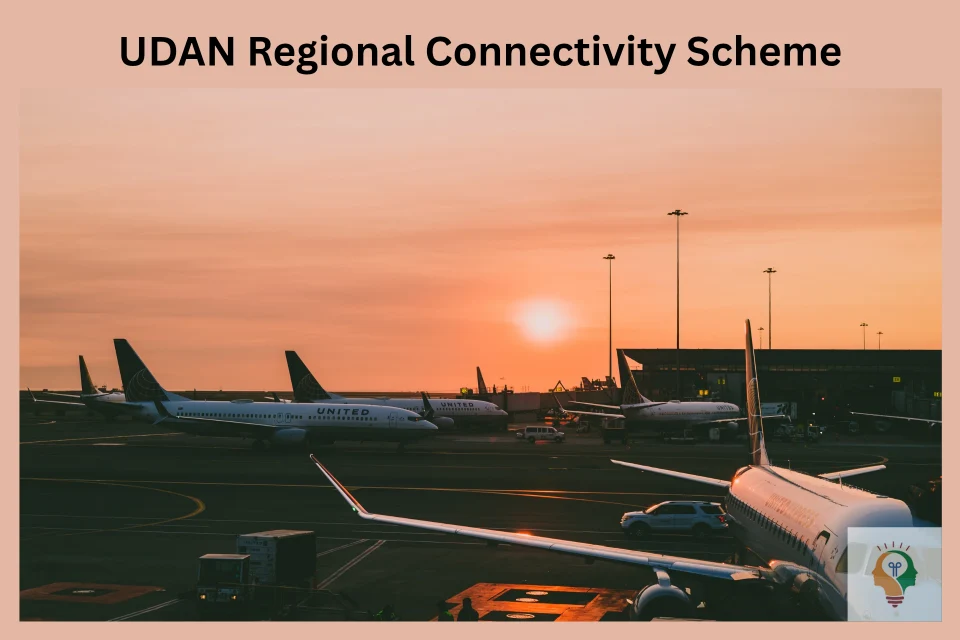



The government of India launched a scheme especially targeting the aviation sector called the Ude Desh ka Aam Naagrik (UDAN)/Regional Connectivity Scheme (RCS), popularly known as the UDAN Regional Connectivity Scheme. The scheme aims to make air travel affordable and accessible for all citizens of India.
Read the article to learn more about the government scheme, including information Regional Connectivity Scheme airports list.
Overview
The table below summarises some key details about the Udan scheme that one should know.
| Name of the scheme | UDAN/RCS |
|---|---|
| Full form | Ude Desh ka Aam Naagrik/ Regional Connectivity Scheme |
| Launched in | 2016 |
| What is Regional Connectivity Scheme objective? | To make air travel affordable and accessible for all citizens of India |
| How to view the Regional Connectivity Scheme airports list? | Through the UDAN Scheme website |
Read more: Blade Found In Air India Food: FSSAI Directs Installation Of X-Ray Machine
What Is The Regional Connectivity Scheme (RCS)?
The Indian government launched a scheme called the Ude Desh ka Aam Naagrik (UDAN)/Regional Connectivity Scheme (RCS) in the year 2016. The primary aim behind the creation of this scheme is to make air travel affordable, especially for people living in tier-II and tier-III cities. The government is planning to achieve this by constructing smaller airports, developing new and improving existing infrastructure to connect even smaller towns to metropolitan cities.
Budget 2025 Update on the UDAN Scheme
The Finance Minister of India announced the expansion of the UDAN scheme in the budget 2025-26. The total budget assigned is around 540 crores, intending to develop 120 new airports over the next 10 years to accommodate around 4 crores passengers.
Read More: How To Address Air Travel Grievances With The AirSewa App By DGCA?
Objectives Of The UDAN Scheme
The government scheme has several objectives that represent its aim. Some of its key objectives are as follows:
-
The main objective of the scheme is to make air travel affordable and accessible for all, especially people from low-income groups, by providing subsidies on air fares. For example: Rs. 2500 for an hour flight.
-
Under the scheme, exclusive focus will be given to establishing Greenfield and Brownfield airports so that connectivity can be widened.
-
The government scheme encourages collaboration between the state and private airlines for proper expansion.
-
Following the UDAN scheme, the fee charged on non-UDAN flights will be used to finance subsidies given on UDAN-covered flights.
Phases Of The UDAN Scheme
The Udan Regional Connectivity Scheme is being implemented in several phases, as laid down below:
-
UDAN 1.0 (2017): In phase 1, 70 airports were established connecting around 128 flight routes, including 36 new airports.
-
UDAN 2.0 (2018): Helipads were added in phase 2 of UDAN with an exclusive focus on establishing 73 airports in remote and hilly areas so that people living there can travel without more issues.
-
UDAN 3.0 (2019): In phase 3, tourist routes and North Eastern Region routes were announced, along with seaplanes for water aerodromes to connect water bodies.
-
UDAN 4.0 (2020): Here, 78 new routes were added, including a connection to the Lakshadweep island, along with special helicopter and seaplane routes under the Sagarmala seaplane service.
-
UDAN 5.0 (2023): In phase 5, distance restrictions were removed, and the authorities focused on category 2 and 3 aircraft to enhance connectivity.
-
UDAN 5.1 (May 2023): This phase worked on helicopter connectivity, reduced airfare by 25%, and increased Viability Gap Funding (VGF) for remote and hilly areas.
Also Read: Carry Alcohol in Domestic Flight | DGCA Rules for Travelers
What Is The UDAN Scheme Eligibility Criteria?
The eligibility criteria for the Udan scheme are mentioned below. This would help you in understanding the proper implementation of the scheme as well. The criteria are:
-
All scheduled or non-scheduled airlines fulfilling the operational criteria can apply for UDAN routes.
-
Only underdeveloped or unserved airports are eligible for the UDAN Scheme.
-
All the citizens of India can avail themselves of the discounted fares.
Provisions of the UDAN Scheme
Major provisions that comprise the Udan Regional Connectivity Scheme are described below for one’s reference:
-
Around 4500 crore was allocated for improving the infrastructure of regional airports.
-
The authorities also announced a levy of Rs. 6,500 per flight on non-UDAN flights, which will be used to subsidise UDAN flights from 2023 to 2027.
-
RCS flights are exempt from landing and parking charges, and AAI is exempt from Terminal Navigation Landing Charges (TNLC) with discounted Route Navigation and Facilitation Charges (RNFC).
-
Aviation fuel at RCS airports is taxed at 2% excise duty for three years, which is the reduced tax rate. VAT on aviation fuel is reduced to 1% or less for ten years, along with lower rates for other services like fire, security, etc.
Components of the UDAN Scheme
There are some components of the government scheme that help the scheme stay true to its objectives. The components are:
-
Viability Gap Funding (VGF): It is a government grant that helps airlines in covering the gap between operational costs and expected revenue. The Regional Connectivity Fund was created to finance VGF and, hence, support the scheme.
-
Aircraft type: Under the scheme, various aircraft are covered, like fixed-wing, helicopters, and seaplanes. Planes are used in proportion to the distance to be covered.
Significance of the UDAN Scheme
Since 2016, the UDAN scheme has achieved a lot of milestones and has proven itself to be quite effective in various ways, like:
-
As of October 2024, 619 routes are working under the scheme, which connects around 88 airports.
-
The number of airports has been doubled from 74 in the year 2014 to 157 in 2024, which caters to around 1.44 crore passengers.
-
As the scheme connects tourist destinations like Khajuraho, Deoghar, and others, regional tourism growth has increased.
Challenges Faced By The UDAN Scheme
Some challenges that the UDAN Regional Connectivity Scheme faces are laid down below in brief points:
-
Many regional routes suffer loss due to low passenger rates, as many passengers, especially from remote areas, still prefer to travel by traditional means of transport, like road rather than flights.
-
Several airports established under the UDAN scheme still lack basic infrastructural facilities.
-
Private airlines have an extremely limited interest in partnering with the government for this scheme, as it isn’t that profitable.
Conclusion
The Ude Desh ka Aam Naagrik (UDAN)/Regional Connectivity Scheme (RCS) is a government scheme that aims to improve the working of the aviation sector through various ways, like increasing accessibility and affordability, widening reach, and expanding its routes.
Stay updated with Jaagruk Bharat to get the latest information on government schemes and more, and reach out to us via our community page if you have any questions or want to share your thoughts.
0

0
1k
0
0
1k Views
0

No comments available