Deep Ocean Mission Complete Overview
Updated: 10-10-2026 at 8:35 AM


2k
The oceans have always been unapproachable, and we know less about the oceans surrounding our wonderful country and the diversity that lies in them. The government of India had been planning for a long time to explore the ocean and assess the opportunities and resources that lay in it. With this ambition, the Indian government has launched the Deep Ocean Mission India.
With the introduction of this mission, the government is not only hoping to explore the Indian Ocean as much as possible with the help of advanced technologies, but also aims to optimally use those resources in the best way possible for both sustainability and development.
Read the article to learn more about the government's mission for the ocean, ranging from its meaning and objectives to components and goals.
Overview
The table below summarises some key details about the India Ocean Exploration Mission that one should know.
| Name of the mission | Deep Ocean Mission |
|---|---|
| Launched by | Ministry of Earth Sciences under the government of India |
| Launched in | 2021 |
| Objective | To explore the resources that lie inside the Indian Ocean and optimally use the Deep Ocean Resources India |
Read More: Exploring The Ganga Kalyan Yojana (गंगा कल्याण योजना). What Are Its Benefits And Application Guide?
What Is The Deep Ocean Mission?
The Deep Ocean Mission is an initiative by the government of India aimed at exploring the oceans that lie around our country. It aims to explore the resources that lie in seas and oceans and introduce sustainable India deep ocean technology for deep-sea exploration and research. It also aims to find a way of using sea resources sustainably.
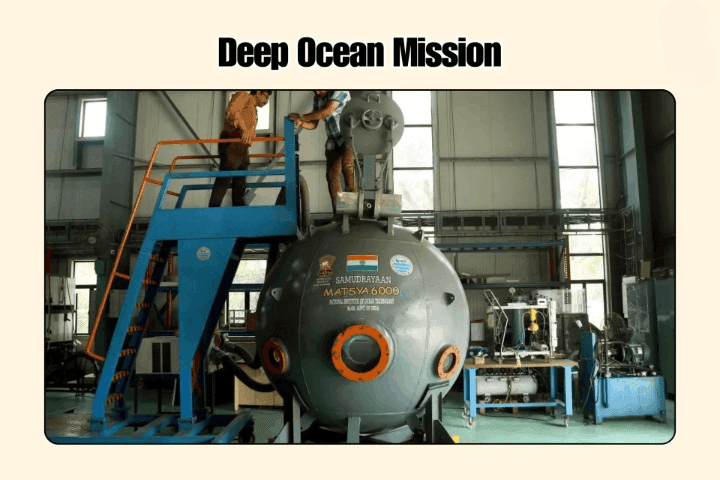
The Deep Ocean Mission was launched in October 2021 by the Ministry of Earth Sciences and has so far introduced multiple ventures, such as the Samudrayaan, which aims to send a man to unimaginable depths for mining and exploring the natural resources beneath.
Objectives Of The The Deep Ocean Mission
Several objectives of this govt mission make it unique and beneficial. Some of the key Deep Ocean Mission objectives are laid out below:
-
One of the main Deep Ocean Mission objectives is to explore the Indian Ocean and excavate as many resources from it as possible. The resources will then be used in various industries for the production of various things in the most sustainable and environmentally friendly manner.
-
Another one of the Deep Ocean Mission objectives is to design and build indigenous technologies, like submarines. This will primarily reduce India's dependence on other foreign countries for advanced tools and will strengthen the domestic tech market.
Benefits Of The The Deep Ocean Mission
The mission concerning deep-sea exploration India comes along with several benefits, some of which are described below in brief points for one’s reference:
-
The first and foremost benefit of deep-sea exploration India can be the excavation of various minerals. This will not only help the country in being sustainable but will also help in becoming self-reliant with reduced imports.
-
One of the indirect benefits of this mission is its potential impact on other sectors, like employment. The mission will require the setting up of new projects, which will need manpower, and will contribute to employment generation.
What Are The Developments Under The Deep Ocean Mission?
India has been allocated a site of 75,000sq km in the Central Indian Ocean Basin by the International Seabed Authority (ISA) for the exploration of polymetallic nodules from the seabed in a 15-year contract.
Furthermore, a deep-sea vehicle named Matsya has been developed, which will take 3 people at a time to a depth of 6000 metres. It has been developed by ISRO in collaboration with NIOT.
What Are The Components Of The Deep Ocean Mission?
The Deep Ocean Mission India has six components. All the components are mentione below in brief points for one’s better understanding:
-
Development of technologies for deep-sea mining and manned submersibles.
-
Development of ocean climate change advisory services.
-
Technological innovations for sustainable use of marine bio-resources.
-
Deep ocean survey and exploration
-
Energy production from the ocean and offshore-based desalination
-
Advanced marine station for ocean biology.
What Are The Goals Of The Deep Ocean Mission India?
There are numerous goals of the India Ocean Exploration Mission that make it stay true to its cause. Some of the popular goals of the mission are as follows:
-
Development of Deep-Sea Technologies: The government has developed Matsya-6000, capable of carrying three people to a depth of 6,000 metres.
-
Exploration and Extraction of Resources: It wishes to explore and be able to mine polymetallic nodules, which contain valuable minerals like manganese, nickel, cobalt, and copper.
-
Ocean Climate Change Advisory Services: Developing a suite of observations and models to understand and provide future projections of important climate variables.
-
Biodiversity and Ecosystem Studies: Studying deep-sea biodiversity and ecosystems to enhance our understanding and conservation of marine life.
-
Support for Blue Economy: The mission focuses on the sustainable use of ocean resources for economic growth, improved livelihoods, and jobs while preserving the health of ocean ecosystems.
-
International Collaboration: Working with international bodies like the International Seabed Authority to ensure responsible exploration and extraction practices.
Read More: PM Programme For Saving Mother Earth: Know Its Benefits And Features Here!
Conclusion
India is transforming its ocean initiatives and taking them to competitive and huge heights. The Deep Ocean Mission India is a step towards that same intended progress in a holistic manner. With the launch of this mission, the government is planning to invest in advanced technologies and research so that India’s position in the global blue economy league can be improved.
The success of this mission will have a huge impact on various sectors, such as employment, which will contribute to India’s sustainable growth and development. This also represents the government of India’s focus on using the Indian Ocean optimally and wisely.
Stay updated with Jaagruk Bharat to get the latest information on government schemes and more, and reach out to us via our community page if you have any questions.
Frequently Asked Questions
0

0
2k
0
0
2k Views
0

No comments available