HSRP Number Plate 2026 | Apply Online, Check Status & Fees | Jaagruk Bharat
Updated: 25-07-2026 at 12:30 PM


17k
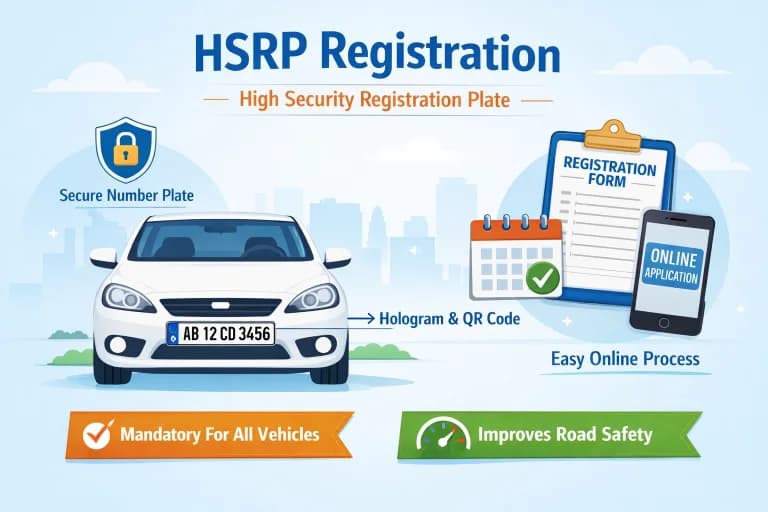
The High Security Registration Plate (HSRP) is now a mandatory requirement for vehicle owners across India, especially for vehicles registered before April 1, 2019. Introduced by the Ministry of Road Transport and Highways under Rule 50 of the Central Motor Vehicles Rules, HSRP aims to bring uniformity, security, and traceability to vehicle identification across the country.
Unlike traditional number plates, HSRP plates are tamper-proof, standardised, and digitally traceable. They come with advanced security features such as a Permanent Identification Number (PIN) and integration with ANPR camera / e-challan integration, making it extremely difficult to duplicate or misuse them.
With increasing cases of vehicle theft, cloning, and traffic violations, the government has made HSRP compliance compulsory to strengthen law enforcement and improve road safety. This guide explains everything you need to know about HSRP plates — from their features and legal importance to documents, fees, and application support.
Overview Of HSRP Number Plate
Before understanding the process in detail, it is important to have a quick look at the key highlights of HSRP implementation in India.
| Detail | Information |
|---|---|
| Full Form | High Security Registration Plate |
| Introduced by | Ministry of Road Transport and Highways (MoRTH) |
| Governing Rule | Rule 50, Central Motor Vehicles Rules (CMVR) |
| Standard Specification | AIS (Automotive Industry Standard) 023 |
| Mandatory For | All vehicles registered before April 1, 2019 |
| Fine for Non-Compliance | ₹5,000 to ₹10,000 (HSRP challan / fine amount) |
| Legal Authority | Section 177, Motor Vehicles Act 1988 |
Also Read: Vehicle Tax Payment Online: Step-by-Step Process & Requirements
What Is HSRP Number Plate? Full Form, Features & Legal Mandate
HSRP (High Security Registration Plate) is a government-approved vehicle number plate system introduced to bring uniformity, enhance security, and reduce vehicle-related crimes across India. It was implemented by the Ministry of Road Transport and Highways (MoRTH) as part of a nationwide initiative to standardise vehicle identification and prevent misuse of fake or duplicate number plates.
The full form of HSRP is High Security Registration Plate, and it is designed using advanced technology that makes it tamper-proof, durable, and easily traceable by authorities. Unlike traditional number plates, HSRPs are centrally registered and linked directly to the vehicle’s engine and chassis number, ensuring complete authenticity.
Key Features Of An HSRP
Understanding what makes an HSRP "high security" helps you verify that what you receive at the fitment centre is genuine.
-
Tamper-proof snap locks: Non-reusable snap locks fasten the plate to the vehicle. Any removal attempt breaks the lock permanently, making tampering instantly visible to enforcement authorities.
-
Retro-reflective sheeting with IND inscription: A hot-stamped film in blue carries the verification inscription "India" and ensures the plate is readable by ANPR cameras in all lighting conditions — including night driving and heavy rain.
-
Chromium-based Ashok Chakra hologram: An internationally recognised security feature that cannot be replicated without government-controlled manufacturing infrastructure.
-
10-digit laser-etched serial number: A unique laser-etched Permanent Identification Number (PIN) is embedded on the plate, which is linked to a centralised database.
-
Central database integration: Every HSRP is permanently associated with one specific vehicle. Cloning one and fitting it to another vehicle will immediately produce a mismatch on any database check. Retro-reflective sheeting ensures high visibility and supports ANPR camera / e-challan integration for traffic monitoring.
-
RFID integration (select states): Some state implementations include an RFID chip enabling automated tolling and vehicle tracking without requiring the driver to slow down at checkpoints.
Legal Mandate For HSRP In India
As per government regulations, HSRP is mandatory for all vehicles operating in India. This rule applies to both new and existing vehicles to ensure a standard identification system nationwide. Authorities have made it compulsory to enhance road safety, curb vehicle theft, and improve tracking in cases of accidents or criminal activities. Driving without an HSRP plate may attract fines between ₹5,000 and ₹10,000 under the HSRP challan / fine amount rules.
Failure to install HSRP within the prescribed timeline can lead to penalties, fines, and legal consequences during traffic inspections. Therefore, vehicle owners are strongly advised to comply with the mandate to avoid unnecessary complications and ensure smooth vehicle operations.
Why Has HSRP Been Made Mandatory?
The shift to HSRP was not just a cosmetic upgrade but a major policy decision aimed at solving long-standing issues in vehicle identification and enforcement. The government introduced this system to address security gaps, improve monitoring, and ensure better compliance across states.
Key Reasons Behind Mandatory HSRP Implementation
Before HSRP, number plates were often inconsistent, easy to duplicate, and lacked standardisation. The new system addresses these challenges through the following improvements:
-
Vehicle theft and cloning prevention: Earlier, number plates could be easily replicated at local workshops, allowing stolen vehicles to operate with fake identities. HSRP introduces a unique laser-etched serial number linked to a central database, making duplication extremely difficult. Additionally, snap-lock fasteners break upon removal, preventing the reuse of plates.
-
Improved automated enforcement systems: Automated traffic enforcement has improved due to ANPR camera / e-challan integration, allowing accurate violation detection.
-
Enhanced ownership transparency: HSRP improves traceability during vehicle ownership transfers, insurance renewals, and RC verification. Authorities can easily cross-check vehicle details through the central database, reducing fraud and ensuring authenticity.
-
Uniformity across the country: Earlier, number plates varied in font, size, and format across states. HSRP ensures standardisation, making vehicle identification consistent nationwide.
Also Read: Subsidy Scheme For Purchase Of Taxi / Goods Vehicle / Passenger Autorickshaw
Documents Required For HSRP
The HSRP application process is designed to be simple and largely digital, which means document requirements are minimal. However, verification is still necessary at the time of installation.
Essential Documents for HSRP
While applying online does not require document uploads, applicants must carry valid documents during fitment to ensure smooth verification.
-
Vehicle Registration Certificate (RC): This is the primary document used to verify ownership and vehicle details.
-
Chassis number: The chassis number must match the details mentioned in the RC to avoid discrepancies.
-
Engine number: This is required to confirm vehicle identity during verification.
-
Valid ID proof: Aadhaar Card, PAN Card, or Driving Licence can be used as identity proof.
-
Registered mobile number: This is used for booking confirmation, OTP verification, and status updates.
HSRP Number Plate For Old Vehicles (Registered Before April 2019)
Vehicles that were registered before April 2019 are required to upgrade to HSRP number plates in order to comply with the latest government regulations. A large number of older vehicles still use conventional number plates, which lack security features and are more prone to duplication or misuse.
To address this issue, the government has made it compulsory for all such vehicle owners to replace their old number plates with HSRP within specified deadlines announced by respective state authorities. This move aims to bring all vehicles under a unified and secure identification system.
Why Upgrading to HSRP is Important for Old Vehicles?
-
Older number plates do not meet modern security standards, making them vulnerable to theft, cloning, and illegal usage.
-
HSRP ensures better traceability, as every plate is uniquely linked to the vehicle’s official records in the central database.
-
It helps law enforcement agencies in quick identification, especially in cases of traffic violations, accidents, or criminal investigations.
Important Points to Consider
-
All vehicles registered before April 2019 must replace their existing plates, as continuing with old plates may lead to penalties.
-
The application process is simple and can be completed online, followed by installation at an authorised centre or through home fitment services in selected cities.
-
Deadlines vary from state to state, so vehicle owners should stay updated with local transport authority notifications.
-
Failure to comply within the given timeline may result in fines, and repeated non-compliance can lead to stricter legal action.
Who Needs To Apply For HSRP? Eligibility & Applicability
HSRP number plates are applicable to almost all vehicle owners in India, regardless of the type, category, or usage of the vehicle. The rule has been implemented to ensure that every vehicle on Indian roads follows a uniform identification system with enhanced security features.
You Need to Apply for HSRP If:
-
Your vehicle was registered before April 2019 and still uses a traditional number plate, which does not comply with the latest HSRP regulations.
-
Your existing HSRP plate is damaged, broken, faded, or not clearly visible, making it difficult to read or verify during inspections.
-
You require an HSRP duplicate/replacement plate due to loss or theft.
-
Your state government has announced deadlines for mandatory HSRP installation, requiring you to upgrade within a specific timeframe.
-
You are transferring ownership of your vehicle, and updated compliance with HSRP norms is required as part of the documentation process.
Who Does Not Need to Apply Separately?
-
Vehicles registered after April 2019 usually come with HSRP pre-installed, as automobile dealers are required to provide HSRP at the time of registration.
-
New vehicle owners do not need to apply separately, unless the plate is damaged or needs replacement in the future.
Why Applicability Matters
Ensuring that your vehicle has an HSRP is essential not only for legal compliance but also for personal safety and convenience. A standardised number plate system helps reduce fraud, improves traffic monitoring, and supports digital governance in the transport sector.
By applying for HSRP on time, vehicle owners can avoid penalties, ensure hassle-free travel, and contribute to a more secure and organised road transport system in India.
Also Read: Kerala High Court Upholds State’s Right to Tax BH-Series Vehicles
HSRP Number Plate Price / Fees — State-wise Complete Table 2026
The cost of an HSRP (High Security Registration Plate) in India is regulated by the government, but it may vary slightly depending on the vehicle type, state policies, and authorised vendors. The pricing generally includes the cost of the number plates, laser coding, hologram, and basic installation charges.
HSRP Fees Structure (2026)
| Vehicle Type | Plate Cost (₹) | Colour Sticker Cost (₹) | Total Estimated Cost (₹) |
|---|---|---|---|
| Two-Wheeler | ₹300 – ₹500 | ₹100 – ₹150 | ₹400 – ₹650 |
| Three-Wheeler | ₹500 – ₹800 | ₹100 – ₹150 | ₹600 – ₹950 |
| Four-Wheeler | ₹600 – ₹1,100 | ₹100 – ₹150 | ₹700 – ₹1,250 |
| Heavy Vehicles | ₹1,000 – ₹1,500 | ₹100 – ₹150 | ₹1,100 – ₹1,650 |
Key Pricing Insights You Should Know
-
The total cost usually includes both front and rear number plates, along with the laser-etched code and installation at the authorised centre.
-
The Colour-coded windscreen sticker may be included or charged separately.
-
HSRP home fitment/home delivery may add ₹100–₹300, depending on location.
-
Prices are standardised by authorities, but slight variations may occur due to logistics, vendor charges, or state-level implementation differences.
-
Bulk bookings or state drives may sometimes offer fixed pricing or limited-time discounts for faster compliance.
Overall, while the pricing is affordable, timely installation helps avoid penalties and ensures compliance with government rules.
How To Apply For HSRP Number Plate Online — Step-by-Step (Book My HSRP)
Applying for an HSRP number plate online is the fastest and most convenient method for vehicle owners. The government has enabled online portals to simplify the process, reduce paperwork, and ensure transparency.
Step-by-Step Online Application Process
Step 1: Go to the authorised platform, BookMyHSRP or your state transport department’s official website.
Step 2: Fill in accurate details such as:
-
Registration Number.
-
Chassis Number.
-
Engine Number.
Ensure all information matches your RC (Registration Certificate).
Step 3: Choose between:
-
Authorised fitment centre visit
-
Home delivery/home installation (available in selected cities)
Step 4: Pick a date and time slot as per your availability for smooth installation without waiting.
Step 5: Pay the required fee using UPI, debit card, credit card, or net banking.
Step 6: After successful payment, you will receive a booking confirmation via SMS or email with appointment details.
Step 7: Installation of HSRP
-
Visit the selected centre on the scheduled date
-
Or wait for the technician if home fitment is selected
Why Is An Online Application Recommended?
-
Saves time and effort with no need to stand in long queues.
-
Ensures accurate data entry and tracking.
-
Provides flexible appointment scheduling.
-
Offers transparency in pricing and process.
This method is ideal for working professionals and urban users who prefer a quick and hassle-free experience. After booking, you can track your HSRP order status online until the plate is fitted.
HSRP Number Plate Status — How To Track Your Order
Once you have successfully applied for your HSRP number plate, tracking your application becomes an important step. It helps you stay informed about progress, avoid unnecessary delays, and ensure you do not miss your installation appointment.
Steps To Track HSRP Status Online
To check your HSRP status, you need to follow a few simple steps carefully so that you receive accurate updates regarding your application.
Step 1: Visit the same official HSRP booking portal from where you placed your order, such as BookMyHSRP or your state-specific website.
Step 2: Locate the “Track Order” or “Order Status” section on the homepage or dashboard.
Step 3: Enter your vehicle registration number, order ID, or registered mobile number correctly.
Step 4: Submit the details to view your real-time application status.
Types Of Status You May See
Understanding the meaning of different status updates helps you interpret your application progress correctly and take action when needed.
-
Processing means that your application has been received and is currently under verification.
-
Approved indicates that your application has been successfully verified by the system.
-
Dispatch shows that your number plate has been manufactured and sent to the selected centre.
-
Ready for installation confirms that your plate is available for fitment or home delivery.
Home Fitment / Home Delivery of HSRP — Is It Available in Your State?
To make the HSRP installation process more user-friendly, many states now offer home delivery and doorstep fitment services. This reduces the need to visit physical centres and makes the process more convenient.
Understanding Home Fitment Service
Home fitment is designed to provide maximum convenience, especially for those who prefer not to visit crowded centres or have time constraints.
-
Home fitment allows authorised technicians to install the HSRP directly at your doorstep.
-
The service eliminates the need to travel to RTO offices or vendor centres.
-
It ensures proper installation by trained professionals using standardised tools.
Availability & Charges
Before selecting this option, it is important to understand where it is available and what additional costs may apply.
-
Home delivery services are generally available in metro cities and selected urban areas.
-
Availability depends on the authorised vendor network in your region.
-
Additional service charges are usually applied for doorstep installation.
-
These charges may vary depending on the state and logistics involved.
This option is particularly helpful for senior citizens, busy professionals, and individuals looking for a hassle-free experience.
Colour-Coded HSRP Windscreen Stickers — Petrol, Diesel & EV
The Colour-coded windscreen sticker is an essential part of the HSRP system and play an important role in vehicle identification. These stickers are affixed to the windscreen and help authorities identify fuel types instantly.
Types of Colour Stickers
These stickers are assigned based on fuel type and must be displayed correctly to comply with regulations.
-
Petrol vehicles are issued a light blue sticker, indicating standard fuel usage.
-
Diesel vehicles receive an orange sticker, helping authorities identify higher-emission vehicles.
-
Electric vehicles are assigned a green sticker, highlighting their eco-friendly nature.
Importance of Colour Stickers
Understanding their purpose helps vehicle owners recognise why they are mandatory along with HSRP plates.
-
These stickers help authorities enforce pollution control measures efficiently.
-
They support traffic management systems and environmental policies.
-
They are used during inspections to quickly identify vehicle categories.
Failure to display the correct sticker can lead to penalties during traffic checks.
HSRP Challan / Penalty — Fine For Not Having HSRP In 2026
HSRP compliance is strictly enforced under the Motor Vehicles Act, and failing to install it can result in heavy penalties. Authorities are actively monitoring vehicles for compliance.
Penalty Details
Before understanding enforcement, it is important to know the financial impact of non-compliance.
-
Fines for not having an HSRP number plate can range from ₹5,000 to ₹10,000.
-
The penalty amount may vary depending on the state and type of violation.
-
Additional penalties may apply if other rules, such as sticker compliance, are also violated.
When Penalties Are Imposed?
Knowing the situations that lead to fines helps vehicle owners avoid unnecessary legal trouble.
-
Driving a vehicle without an HSRP plate attracts immediate penalties.
-
Using non-standard or tampered number plates is considered a violation.
-
Missing or incorrectly coloured stickers can also lead to fines.
Strict enforcement makes it essential for vehicle owners to complete HSRP installation on time.
HSRP For New Vehicles vs Old Vehicles — Key Differences
Understanding how HSRP rules differ for new and old vehicles helps avoid confusion and ensures proper compliance with regulations.
Key Differences Explained
The requirements vary significantly depending on the vehicle registration date, and knowing these differences is crucial.
-
New vehicles registered after April 2019 come with HSRP pre-installed by the dealer at the time of purchase.
-
Old vehicles must apply separately before the HSRP last date 2026 / deadline.
-
The responsibility of compliance lies with the owner in the case of older vehicles.
-
Deadlines and penalties are mainly applicable to vehicles that still use old number plates.
Also Read: Road Tax Rules In India: Motor Vehicle Taxation & Compliance
How To Apply For A Duplicate Or Replacement HSRP Plate
If your HSRP plate is damaged, lost, or unreadable, applying for a replacement becomes necessary to maintain compliance and avoid penalties.
Steps to Apply for Replacement
The process is straightforward, but it must be followed carefully to avoid errors or delays.
Step 1: Visit the official HSRP booking portal and select the replacement or duplicate option.
Step 2: Enter your vehicle registration details and previous HSRP information correctly.
Step 3: Choose your preferred installation method, either centre-based or home fitment.
Step 4: Complete the payment process using the available online payment methods.
Step 5: Attend the scheduled appointment or wait for home installation to receive your new plate.
State-Wise HSRP Portals & Deadlines — All India 2026
HSRP implementation in India is carried out at the state level, which means each state follows its own portal system, deadlines, and enforcement mechanisms. Vehicle owners must stay updated with their respective state guidelines to avoid penalties.
HSRP Number Plate Delhi — BookMyHSRP Portal
In Delhi, the government has implemented a strict and well-monitored HSRP system through the BookMyHSRP portal. Vehicle owners are required to complete the installation within the notified deadlines, especially for vehicles registered before April 2019. The state offers both centre-based installation and home fitment services, making the process accessible and convenient. Traffic authorities in Delhi conduct frequent compliance checks, and penalties are actively imposed on vehicles that fail to meet HSRP requirements.
HSRP Number Plate Maharashtra — Deadline & How to Apply
Maharashtra has also enforced HSRP compliance for all vehicles, particularly focusing on older vehicles that still use traditional number plates. The state follows a phased deadline system based on vehicle registration numbers, allowing systematic implementation across regions. Vehicle owners can apply through authorised vendor portals and book installation appointments easily. Enforcement has increased significantly in cities like Mumbai and Pune, where traffic authorities regularly monitor compliance and issue penalties for violations.
HSRP Number Plate UP — FTA HSRP / SIAM Portal
In Uttar Pradesh, HSRP application is managed through SIAM and FTA-authorised portals, ensuring a structured and digital process. The state often announces district-wise deadlines to manage large volumes of vehicles efficiently. Vehicle owners can choose between online booking and authorised centre visits for installation. Enforcement is gradually increasing across major cities and highways, making it important for vehicle owners to complete the process within the specified timelines to avoid fines.
HSRP Number Plate Haryana, Karnataka, MP & Other States
States such as Haryana, Karnataka, and Madhya Pradesh have also implemented HSRP systems through their respective authorised portals. Each state follows its own timeline and compliance deadlines, which may vary depending on administrative planning and vehicle density. Enforcement is steadily increasing across these states, and authorities are actively encouraging vehicle owners to upgrade to HSRP plates. It is advisable for vehicle owners to regularly check official announcements and complete the installation process well before deadlines to ensure compliance.
Conclusion
HSRP number plates are no longer an optional upgrade but a legal necessity for vehicle owners in India. With strict enforcement across major states like Delhi, Maharashtra, Karnataka, and Haryana, non-compliance can lead to heavy penalties, including fines up to ₹10,000 and possible vehicle impounding.
The process of applying for HSRP is simple, quick, and largely digital, typically taking less than 15 minutes to complete. The cost is also affordable, usually under ₹900 for most vehicles, making it a small investment for long-term compliance and security.
Vehicle owners, especially those with vehicles registered before April 2019, should prioritise installing HSRP plates at the earliest. Delaying the process can result in unnecessary legal complications and financial penalties.
By taking timely action and using reliable assistance platforms like Jaagruk Bharat when needed, you can ensure smooth compliance, enhanced vehicle security, and complete peace of mind.
Why Choose Jaagruk Bharat for HSRP Assistance?
Jaagruk Bharat provides guided assistance to help vehicle owners complete the HSRP application smoothly without facing common errors or delays.
With experience in assisting over 500,000 users, Jaagruk Bharat offers a reliable and hassle-free way to complete HSRP registration.
Get the latest updates on government schemes and policies with Jaagruk Bharat. Join India's biggest Jaagruk Bharat community. Share your thoughts, questions, and favourite topics with us.
Frequently Asked Questions
0

0
17k
0
0
17k Views
0

No comments available