Legal Heir Certificate 2026: Apply Online, Documents, Process & Difference from Succession Certificate | Jaagruk Bharat
Updated: 20-06-2026 at 3:30 PM


6k
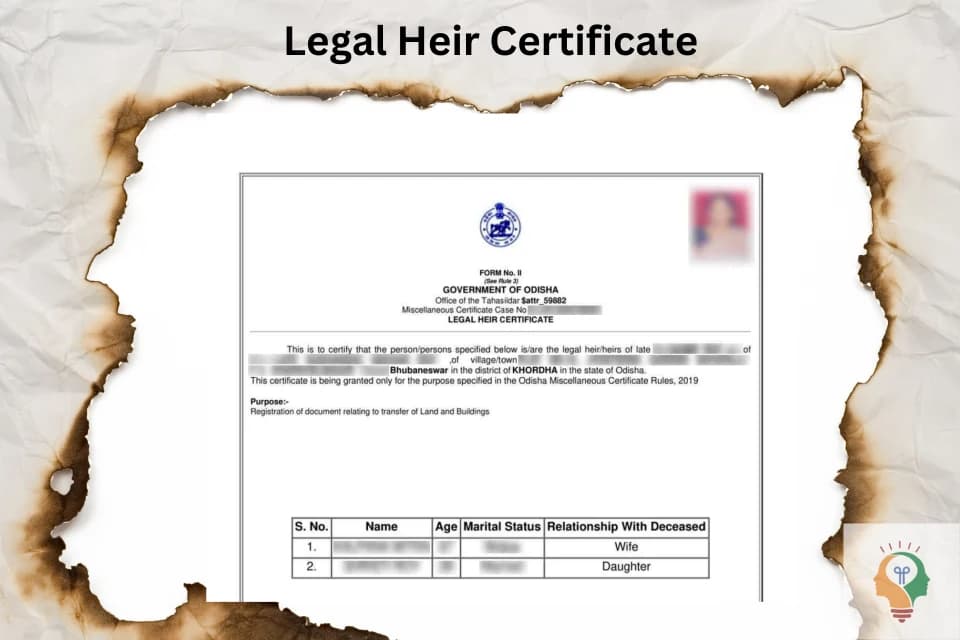
Complexities are often involved in matters of inheritance, succession, and property transfers. That is why the government of India created the provision of a Family Legal Heir Certificate. The certificate helps the family members of the deceased in proving their relationship, thus helping the authorities identify the rightful legal heirs entitled to the assets of the person who is no longer alive. It is one of the most important documents that helps maintain a smooth functioning of the inheritance laws and property transfers with as few chances of conflicts as possible.
Read the article to learn about the details of the family Legal Heir Certificate, application for legal heir certificate, documents required for legal heir certificate, and much more.
Legal Heir Certificate Overview
This table provides key details about the application of the Legal Heir Certificate, including its issuing authority, purpose, validity, and application process. It serves as a quick reference for anyone seeking to understand its importance and procedure.
| Name of the certificate | Family Legal Heir Certificate. |
|---|---|
| Issued by | Revenue Department or Municipal Corporation. |
| Objective | A Legal Heir Certificate is made upon the request of a family member, wherein they select their successors and document them legally. |
| Validity | Valid for life. |
| Apply for a legal heir certificate | Online via the state government dedicated portals or offline by visiting the offices of the concerned authority, like the Tehsildar. |
Read More On Uttarakhand Uniform Civil Code (UCC): Everything You Wanted to Know
What Is A Legal Heir Certificate? (Meaning, Regional Names & Legal Basis)
A legal heir certificate is an official, legally binding document issued by the relevant revenue authorities of a state government. The document helps the family members of a deceased individual, like spouse, children, parents, or other blood-related relatives (only when the immediate family is not present) in proving the fact that they were related to the deceased and, hence, are the rightful owners of the assets of the person who is no longer alive.
The legal heir certificate is known by various names across various places, such as Varisa Patra / Waris Certificate / Surviving Members Certificate, Heirship certificate, Family Member Certificate, and others. The names might be different, but they all represent the same thing.
There is no single unified law or authority that governs the functioning of the legal heir certificate. It operates as per various succession laws, like the Hindu Succession Act of 1956, Muslim Personal Law, and the Indian Succession Act of 1925. Based on the legal heir's religious background, the concerned law comes into action.
Contents Of A Legal Heir Certificate
The application of the Legal Heir Certificate comprises several components to make information clear and valid. The major things it consists of are as follows:
-
Name and address of the deceased.
-
Date of the death of the deceased.
-
Details of the legal heir, such as name, address, and relationship with the deceased.
-
Details of the issuing authority.
-
Date of the issue of the certificate.
Benefits Of A Legal Heir Certificate
There are several benefits of applying for a legal heir certificate that make the lives of successors easy and conflict-free. Some of its major benefits are described below in brief:
-
Helps in the identification of rightful successors.
-
Legal heirs can claim the assets of the deceased through the government document.
-
The govt certificate also enables the legal heirs to claim insurance, receive pension, provident fund, and salary arrears of the deceased.
-
In some cases, legal heirs can also use their legal heir certificates to secure employment opportunities.
Who Can Apply For A Legal Heir Certificate in India?
Immediate family members of the deceased individual are usually the eligible people who can apply for a legal heir certificate. However, in the country of India, inheritance is governed by various laws drafted for various religious groups and communities. Revenue departments work as per the provisions of these laws. Eligible entities as recognised under various significant related laws are described below for one’s reference.
Class-I Heirs Under The Hindu Succession Act 1956
People who come from the religious communities of Hindus, Buddhists, Jains, and Sikhs have their legal heirship rights governed by the Hindu Succession Act of 1956. The immediate family members of the deceased individual are categorised as Class I heirs, meaning the top-most people in regard to succession.
After the amendment in the Hindu Succession Act that happened in 2005, daughters are also legally allowed to enjoy inheritance rights as sons do. The table below classifies the Hindu Succession Act 1956 / class-I heirs for one’s deeper understanding:
| Hindu Succession Act 1956 / class-I heirs | Classified as |
|---|---|
| Mother | Primary class I heir. |
| Widow | Primary class I heir. |
| Son | Primary class I heir. |
| Daughter | Primary class I heir. |
Read More On When Can A Daughter Not Claim Her Father's Property? | Inheritance & Property Law
Eligibility Under The Indian Succession Act 1925 (Christians, Parsis, Jews)
Succession rights of people who come from the religious communities of Christians, Parsis, and Jews are governed by the Indian Succession Act of 1925. Under this particular act, the following family members of the deceased individual are considered the eligible heirs and thus legally entitled to inherit the deceased’s assets:
-
Husband or wife of the deceased.
-
Children of the deceased.
-
Grandchildren and other lineal descendants.
-
Parents of the deceased.
-
Brothers and sisters of the deceased, if there are no immediate family members of the deceased.
Muslim Heirs Under Muslim Personal Law
For people who identify themselves as Muslims, their succession rights are governed by the Muslim Personal Law (Shariat). Legal heirs are determined on the basis of various factors, like the school of Muslim Law and the relationship they shared with the deceased individual. Eligible legal heirs include the following:
-
Spouse of the deceased.
-
Children of the deceased.
-
Parents of the deceased.
-
Grandchildren of the deceased, and other blood-related relatives, if close family members are absent.
How To Apply For A Legal Heir Certificate: Step-by-Step Process (2026)?
Eligible individuals can apply for the legal heir certificate by following the process mentioned below. The application process is broken down below in a stepwise manner for one’s better understanding and clarity.
Step 1 — Obtain The Death Certificate First
The first step towards applying for a legal heir certificate is obtaining the death certificate of the deceased. The death certificate proves that the person has passed away, and their assets can now be distributed among the legal heirs. The municipal corporation, gram panchayat, or other local offices usually issue it.
Step 2 — Assemble The Document Set (With Stamp Paper Affidavit)
After collecting the death certificate, make a folder of all the required supporting documents that you will need to upload or submit to the authorities at the time of application for a legal heir certificate. Documents such as Aadhaar cards of family members, birth certificates, photographs, and others need to be present in the folder. You will also be required to get a notarised affidavit on stamp paper, mentioning the details of the deceased and the legal heirs.
Step 3 — Apply Offline At The Tehsildar / Mamlatdar / SDM Office
If you prefer the offline mode of application, please visit the office of the Tehsildar / Mamlatdar / SDM (Sub-Divisional Magistrate), or the taluka office during working hours. Request a staff member to provide you with an application form for the legal heir certificate. Fill in all the details in the form carefully and accurately. Attach the copies of the self-attested documents to the form. Review the details filled in the form once before making the final submission. Pay the nominal charge and submit your application.
Step 4 — Apply Online: State-Wise Portal Guide (Maharashtra, Delhi, Karnataka & More)
Applicants who prefer the online mode of application can do so by visiting the official websites of the e-governance of their respective state governments. Various state governments now provide the service of online application for a legal heir certificate, such as the legal heir certificate online Maharashtra / Delhi / Karnataka, and others.
After opening the dedicated portals for the same based on one’s state, register on the portal, search for the ‘Legal Heir Certificate’ option, and enter the details in the application form. Then, proceed to attach the scanned copies of all the required documents as per the prescribed size and format as mentioned on the portal. Recheck everything once to make sure that there are no errors, and then pay the nominal fee charged by the authorities for providing the service. The fee can be paid via any of the online payment methods, like debit or credit card, UPI (Unified Payment Interface), net banking, etc. After successful fee payment, your application will be considered submitted.
Step 5 — Lekhpal / Revenue Inspector Field Verification
After the successful submission of applications, the next step is Lekhpal / talati / revenue inspector verification. Based on your state, the concerned authority in charge will begin the background verification, wherein they will check the information filled by you in the form and the authenticity of the attached documents. They might also visit your residence and interact with the neighbours and other family members to ensure that there are no more legal heirs to the property of the deceased.
Step 6 — Certificate Issuance & Certified Copies
If the authorities end up finding no discrepancies or faults with your application, your application will be approved, after which they will draft and issue the legal heir certificate in your name. One can either collect the final certificate from the concerned office or download it from the state government’s portal.
Documents Required For A Legal Heir Certificate
To successfully apply for the official government certificate, one needs to submit some supporting documents. The list of documents required for a legal heir certificate is as follows:
-
Proof of residence of the deceased and the legal heir.
-
Death certificate of the deceased.
-
Birth certificate of the legal heir.
-
Self-declaration.
-
Family tree affidavit / stamp paper affidavit.
Fee And Processing Timeline By State (2026)
The fee charged at the time of applying for a legal heir certificate and the processing time vary from one state to another and are based on various factors, like issuing authority, specifics of verification, mode of submission of applications, etc. We have created a table that comprises an approximate fee range and processing time of legal heir certificates of major states:
| Name of the state | Legal heir certificate fee ₹ / stamp paper cost | Legal heir certificate time limit / how many days |
|---|---|---|
| Maharashtra | Ranges from Rs 20 to Rs 100. | Around 15 to 30 days. |
| Delhi | Nominal charges. | 14 to 30 days. |
| Karnataka | Ranges from Rs 25 to Rs 60. | Approximately 21 days. |
| Telangana | Ranges from Rs 35 to Rs 100. | Around 15 to 21 days. |
| Andhra Pradesh | Ranges from Rs 35 to Rs 100. | Around 15 to 21 days. |
| Uttar pradesh | Ranges from Rs 30 to Rs 100. | Approximately 15 to 30 days. |
Escalation Path If Tehsildar Delays Your Certificate
If your legal heir certificate application is showing as ‘pending’ or ‘under review’ beyond the prescribed processing timeline, you should not spend your time waiting; instead, escalate the matter and reach out to the grievance redressal mechanism for immediate answers and solutions. The correct way of doing so is mentioned below in detail for one’s reference:
Level 1: The first person to approach in this regard is the Tehsildar. Write a formal application with all the necessary details, like your application number, date of submission of application, acknowledgement receipt, and others. Usually, long delays happen due to incomplete information in the application form or invalid documents.
Level 2: If the Tehsildar fails to help you resolve the issue and you have received no satisfactory answer from them, you can take this matter to the Sub-Divisional Magistrate or the Revenue Divisional Office (RDO). They are in charge of overseeing the functioning of the sub-departments and can help you find out the root cause of the delay concerning your application.
Level 3: If, unfortunately, the delay continues and the SDM or RDO fails to resolve the issue for you, file a formal complaint to the District Magistrate (DM) or the District Collector. They are the head of the district administration and therefore have the authority to call upon the heads of the sub-departments and demand clarification concerning the issue. Make sure to take all the documents proving that the previous authorities, like Tehsildar and SDM, were reached, but no action was taken.
Level 4: One can also file an appeal with authorities like the Right To Service (RTS) Commission, which has been created by the state government authorities for laying out laws concerning time limits for processing of applications and issuance of certificates. The RTS commission also helps people with various issues, including delayed applications.
Level 5: If the issue remains unsolved by all the levels mentioned above, lodge a complaint through the Centralised Public Grievance Redress and Monitoring System (CPGRAMS) portal. This is a public grievance redressal mechanism wherein citizens can file complaints concerning unexplained delays, administrative inaction, and other issues faced with government departments. The CPGRAMS portal also allows applicants to track the status of their complaints.
Where Is A Legal Heir Certificate Accepted? (LIC, PF, Bank, Property)?
A legal heir certificate is an official legal document that is widely accepted by various government departments for various purposes, such as a legal heir certificate for bank / LIC / PF / pension claim. Some of its most common and popular uses are described below in detailed points, so that one can have an idea about its significance and practicality
-
Insurance companies, like the Life Insurance Corporation of India (LIC), accept a legal heir certificate when it comes to the processing of claims involving a deceased policyholder. The certificate helps the insurance companies in verifying the identities of the legal heirs and making informed decisions concerning the release of the funds to the rightful people.
-
A legal heir certificate also comes in extremely handy when the deceased’s legal heirs are applying for claiming the provident fund balances, gratuity payments, or other pension-related claims of the deceased employee. Both the public and private sector relies the legal heir certificate to verify the identities of the rightful legal heirs of the deceased.
-
Financial institutions, like banks, usually request legal heirs to present a legal heir certificate if wanting to access the deceased’s account. This request is made by the banks in case an account holder dies without nominating any nominee. With the help of a valid legal heir certificate, rightful legal heirs are given control over the bank accounts of the deceased and claim the balance in the account, fixed deposits, check locker, etc.
-
A legal heir certificate is also an important document when it comes to property transfers. However, note that when it comes to transferring ownership of an immovable property of the deceased, a legal heir certificate is not the only document that is sufficient; other supporting documents are also requested by the authorities.
Legal Heir Certificate Vs Succession Certificate: Key Differences
Key differences between a succession certificate vs legal heir certificate RBI ₹1.5 lakh are mentioned below in tabular format for one’s reference:
| Components | Legal Heir Certificate | Succession Certificate |
|---|---|---|
| Meaning | Drawn up by the deceased, wherein he/she select their legal heirs. | Helps in transferring assets after the death of the deceased under the Hindu Succession Act. |
| Issued by | Local revenue authorities like the Municipal Corporation | Civil courts |
| Who can apply? | Spouse, children, or parents of the deceased | Legal heirs of the deceased if there is no will. |
| Legal process | Simple | Comparatively complex, as it requires legal proceedings |
| Used for | Inheritance claims or for claiming the deceased’s pension, insurance, etc. | Transfer of assets in case of no will |
How To File ITR On Behalf Of The Deceased As Legal Heir?
After the death of the deceased, it is the responsibility of the legal heirs to file an Income Tax Return (ITR). They can do so by:
Step 1: Visit the official website of Income Tax.
Step 2: Register using your information and create an account.
Step 3: After registration, log in to your account and navigate to ‘myAccount’.
Step 4: Find the request type option and click on ‘Adding/Registering a representative on behalf of someone else’.
Step 5: Select the deceased’s estate to continue registering.
Step 6: Fill out all the deceased’s relevant information, like the name of the estate, the deceased’s date of incorporation, etc.
Step 7: Upload the supporting documents of the deceased, like a PAN card, death certificate, legal heir certificate, and a self-declaration.
Step 8: Apply to be able to file ITR on behalf of the deceased.
Common Reasons Your Application Gets Stuck (and How to Fix Each)
When it comes to obtaining a legal heir certificate, the state government authorities have done their best to make the process as easy and clear to the people as possible. However, people still commit some mistakes that end up delaying the processing of their applications for several days and weeks.
Some of the common mistakes committed by people and the ways to resolve them are mentioned below in brief points so that you can avoid them when applying for a legal heir certificate:
-
One of the most common reasons for delays in processing applications is inconsistency in records. Details are mismatched in the application form and the attached or uploaded documents, which confuses the authorities and complicates the verification check. The best way to resolve this issue is to be alert when filling in details in the application form. Review the details at least once or twice before making the final submission to avoid this particular issue.
-
Another issue is the legal heir certificate correction / name missing, meaning the name of the heir is not present in the legal heir certificate. This can be accidental when people miss out on filling in the complete details asked in the application form. Due to this error, heirs whose names are missing from the certificate will face immense difficulties in exercising their right over the deceased’s assets.
This problem can be resolved when the omitted heir submits a correction request to the concerned authority, like Tehsildar / Mamlatdar / SDM. Submit the application for correction with supporting documents to back up your claim, after which the authorities will conduct a new verification check, and if satisfied, a new legal heir certificate will be issued.
-
Oftentimes, applications are also delayed because of missing documents. Applicants forget to attach or upload all the required supporting documents, which creates a major issue for the authorities, as without ample documents, they cannot proceed with the verification checks. Therefore, please compile the documents before applying for a legal heir certificate and make sure they are in the prescribed size and format as mentioned on the online portal.
Conclusion
A legal heir certificate is one of the most significant documents needed by the family members to prove the kind of relationship they shared with the deceased individual. The certificate helps them in establishing their identities so that they can conduct various functions, like claim the deceased’s pensions, insurance proceeds, take control of the bank account holdings, etc.
People who are planning to apply for this certificate are advised to go through every single section of this article, as it explains the specific aspects concerning a legal heir certificate in detail and in easily comprehensible words.
Stay updated with Jaagruk Bharat to get the latest information on government schemes and more, and reach out to us via our community page if you have any questions or want to share your thoughts.
Why Choose Jaagruk Bharat To Apply For A Legal Heir Certificate?
Allow Jaagruk Bharat to help you and apply on your behalf for a Legal Heir Certificate in just a few clicks! Get 24/7 support, expert assistance, online services, and a hassle-free application Process with Jaagruk Bharat.
Frequently Asked Questions
0

0
6k
0
0
6k Views
0

No comments available