How To Check Eligibility For Multiple Government Schemes At Once In India? Complete Guide For 2026
Updated: 20-05-2026 at 3:30 PM


1k
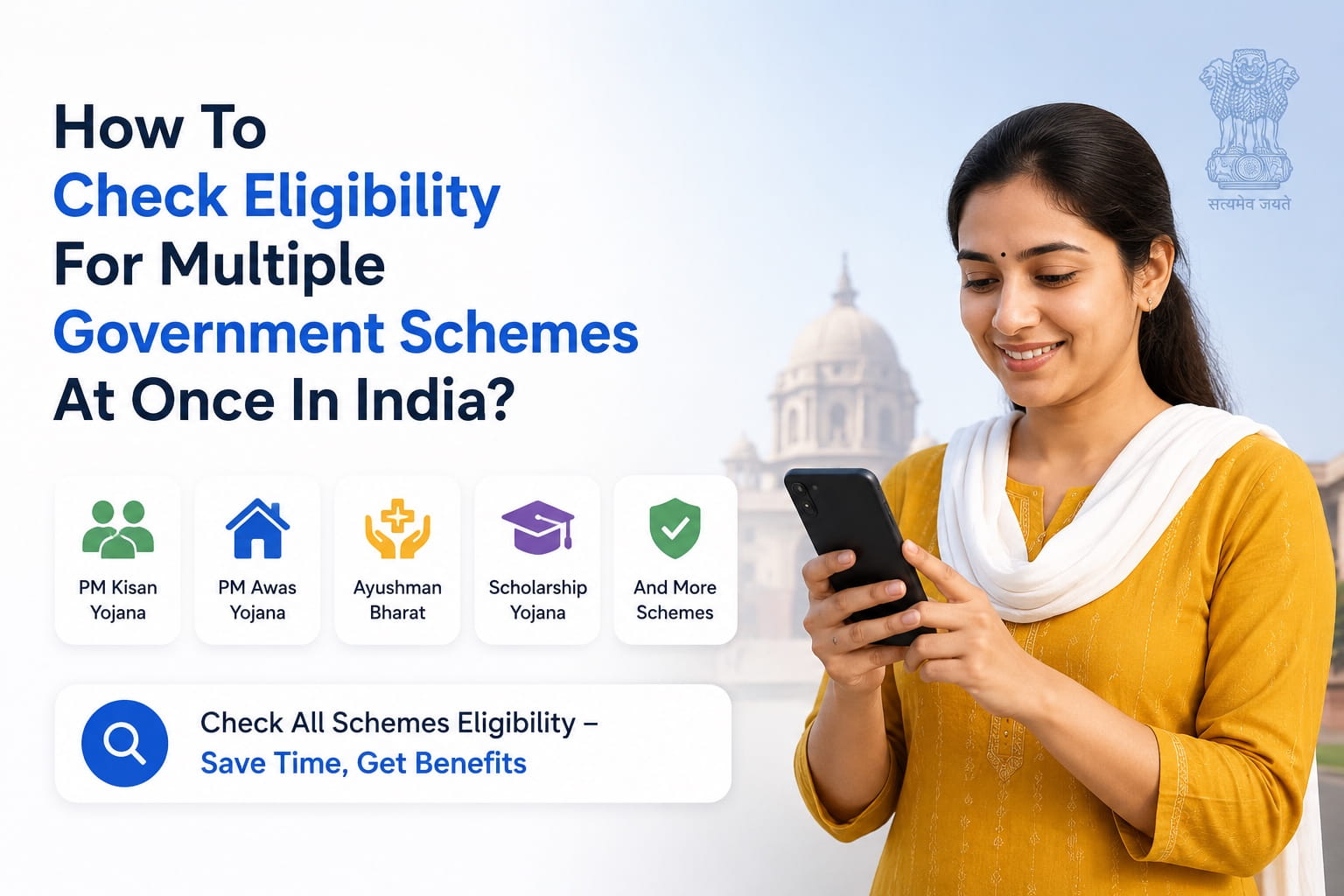



There are hundreds of welfare schemes of the Government of India and State Governments for students, women, farmers, senior citizens, labourers, economically weaker sections, widows and people with disabilities. Many people, searching for one ID for all government schemes in India, are not aware of the multiple benefits that they can avail from such facilities, since they do not know which schemes they are eligible for or where they can check their eligibility properly.
To solve this problem, the government has introduced digital portals and integrated beneficiary systems that allow citizens to verify eligibility for multiple schemes together. These platforms assess people's data, including age, income, caste category, occupation, state, gender, social status and recommend the schemes automatically.
Having more such platforms can save citizens' time and effort, prevent the duplication of paperwork submissions, and provide financial assistance, scholarships, pensions, subsidies and insurance, housing benefits, and employment support.
In this article, you will get the detailed information about the DBT schemes using one ID in India, various welfare schemes, how to apply multiple schemes with one ID and where to check your eligibility for them.
Overview Of Multiple Government Scheme Eligibility Check
The concept of 'Digital India' has enabled access to many welfare services from home on Aadhaar-linked platforms and state service portals online, as the table below highlights:-
| Particulars | Details |
|---|---|
| Service Name | Government Scheme Eligibility Check |
| Objective | To help citizens identify multiple eligible welfare schemes together. |
| Applicable Beneficiaries | Students, women, farmers, labourers, senior citizens, unemployed youth, PwDs and others. |
| Mode Of Access | Online and offline. |
| Major Platforms (one ID for all government schemes, India) | MyScheme Portal, UMANG App, State Welfare Portals and CSC Centres. |
| Documents Required | Aadhaar Card, income proof, domicile certificate, caste certificate and bank details. |
| Main Benefit (DBT schemes using one ID in India) | Easy discovery of multiple welfare schemes through one platform. |
| Operated By | Central Government and respective State Governments. |
Also Read: What To Know About The LPG-Aadhaar Linking?
What Does Checking Eligibility For Multiple Government Schemes Mean?
Multiple scheme eligibility checking involves a government website or welfare service to look at your personal and financial circumstances to see if you are eligible for any of the schemes. The advantage of the integrated portals is that they automatically compare data from your application with the schemes available, so there is no need to review each one individually. Typically, the process involves the following information:
-
The applicant's age, gender and category are used to identify the appropriate schemes based on the government conditions of eligibility.
-
Income Details are used by the help welfare portals to determine eligibility for subsidies, scholarships, financial assistance and other welfare assistance programmes.
-
Several schemes are applicable only in certain States or UT's, and hence, the State of Residence is important.
-
Occupational information assists welfare systems in aligning citizens with farmer schemes, labour benefits, business loans and/or employment programmes.
-
Scholarship Schemes, coaching assistance and student support programmes often require educational details.
Why Is It Important To Check Eligibility For Multiple Schemes Together?
A lot of citizens do not know of the welfare benefits available because government schemes and initiatives are administered by various ministries and departments. Combined checks enable individuals and families to secure maximum government support.
This also helps to eliminate confusion and makes it easier for applicants to avoid making multiple visits to government centres. Citizens can effortlessly identify welfare benefits to support their economic, educational, healthcare, housing and employment status through integrated welfare systems.
The following are some of the ways multiple schemes can help applicants:
-
Applicants can save significant time, and they don't have to research each and every government scheme independently.
-
Families can receive better financial support by applying for multiple welfare schemes at the same time.
-
Online eligibility platforms help citizens identify the government benefits that they may have missed out on.
-
Integrated welfare systems filter out non-relevant welfare schemes that do not match the applicant's profile, reducing confusion.
-
Digital Platforms streamline the application process as they minimise documentation requirements and manual verification.
Information Required To Check Eligibility For Government Schemes
Applicants should make sure to have relevant documents and personal information on hand before using the website to verify eligibility. Welfare systems can show correct suggestions for schemes with proper information.
-
Aadhaar-Based Verification and Identity Information: Many individuals ask can we apply multiple govt schemes with Aadhaar, making Aadhaar-based verification an important part of government welfare systems because it helps to minimise duplicate beneficiaries and ensure transparency.
-
Income & Financial Details: This actually gives information about income, which is a major factor for deciding whether a household is eligible for subsidy payments or welfare payments.
-
Residential and Social Category Document: Many schemes are accessible only to certain social groups, or they’re limited to particular states. Applicants should keep and maintain these records.
-
Domicile Certificate to prove the residence of a particular State/UT in the Union of India.
-
Caste Certificate for SC, ST, OBC and Minority candidates.
-
Disability Certificates for disability welfare programmes and reservation benefits are entitled to Disability Certificates.
-
How To Check The Eligibility For Multiple Government Schemes Online?
Digital welfare platforms have made it easier to verify eligibility for multiple schemes online. Applicants can complete the process from home through their mobile phones or computers.
Step 1: The applicant is required to first log in to a trusted government welfare portal like MyScheme, UMANG or the respective State government welfare website.
Step 2: Most portals offer a “Find Schemes For You” or “Eligibility Checker” module, which users can use to get the process of finding suitable schemes underway.
Step 3: Applicant must submit correct information (Age, Gender, Occupation, Annual Income, Social category, Educational qualification and residence location).
Step 4: For some portals, the applicant might be asked to log in using their OTP verification after entering their Aadhaar number to support customer identity and enhance the effectiveness of the scheme matching.
Step 5: Government schemes that match the applicant's requirements are automatically displayed on the portal. Users are then provided the chance to look through the details of the scheme in detail.
Step 6: Carefully review the eligibility criteria, required paperwork, benefits, and deadlines before deciding which scheme to opt for or submitting applications.
Types Of Government Schemes That People May Qualify For
An individual might be eligible for more than one welfare scheme offered by the government, based on their income, employment, caste, age, gender, incapacity, etc., and their home or birth location. Both the Central Government and State Governments operate various programmes for the support of the financially weaker section and to facilitate access to education, healthcare, employment, housing, and social protection. Awareness of the types of schemes makes citizens available for support when they apply for the schemes suitable for them.
Scholarship and Study-Related Schemes
There are numerous study help programs and scholarships offered by the Government of India and/or State Governments for students from economically and socially weaker sections. These schemes are generally aimed at reducing dropouts and enhancing accessibility to higher education, as well as helping students who appear for competitive exams. Depending on a combination of elements, such as family income, grade point average and category, a student can be eligible for more than one education scheme at the same time.
Women's Welfare Schemes
Women throughout India may qualify for many welfare schemes that focus on financial assistance, medical care, entrepreneurship, self-employment, and social security. These programmes are meant to push women's empowerment forward, strengthen maternal health, and help with economic self-reliance. Several welfare plans also target widows, single women, rural women, and women from low-income households, so the eligibility can vary quite a bit by situation.
Farmer welfare schemes
Farmers and people who work on farms are eligible for a bunch of welfare schemes that are brought to boost agricultural output, also to cut down financial stress. These programs assist small farmers plus marginal farmers, mainly via direct cash support and subsidies to make their fluctuating income a bit steadier. On top of that, government agricultural schemes make it easier for farmers to handle losses when crops fail, when natural disasters hit, or when the weather conditions start shifting in unpredictable ways.
Labour welfare schemes
Construction workers, daily wage earners, and workers from unorganised sectors can also qualify for labour welfare schemes. Usually, they are designed by the Central and State Labour Welfare Boards. The whole point is to offer social security and some financial backing for workers and their families. In many cases, registered workers get benefits connected to healthcare, schooling, housing, insurance, and pension-related support, which can really help them in tough times.
Benefits Of Using Online Welfare Eligibility Platforms
Digital welfare platforms have made things smoother for citizens who want to find and apply for multiple government schemes without going to several offices physically multiple times. These online portals tend to improve transparency, and they reduce confusion about eligibility conditions. The major benefits of using online welfare eligibility platforms are described below:
| Benefit | Explanation |
|---|---|
| Faster Access | Citizens can discover multiple welfare schemes quickly from home. |
| Better Transparency | Applicants can clearly view eligibility conditions and benefits. |
| Reduced Paperwork | Online systems minimise physical documentation requirements. |
| Improved Awareness | Citizens learn about welfare schemes that they were previously unaware of. |
| Easier Applications | Digital platforms simplify scheme registration and verification processes. |
How Jaagruk Bharat Helps Citizens Understand Government Schemes?
Jaagruk Bharat is helping citizens to gather information on government schemes and welfare programmes in a simple and easy-to-understand language. It also simplifies eligibility criteria, which can be quite complex, and application processes so that individuals with diverse backgrounds can easily understand the information without being overwhelmed.
What Happens If People Do Not Check Their Scheme Eligibility Properly?
Many citizens end up losing out on valuable financial benefits and welfare opportunities, primarily due to the lack of verification if they are eligible for government schemes. There are times when it's simply a matter of ignorance, and that has a way of affecting education, healthcare, job opportunities and even future financial stability. When people don't verify eligibility correctly, it can lead to several drawbacks, including:
-
Families can miss out on scholarships, pensions, and other financial supports, which could ease their day-to-day strain, but in some cases, it just slips by unnoticed.
-
Labourers may also lose eligibility for insurance cover, housing support, and a few other worker welfare benefits that are provided by the Government.
-
Farmers might lose out on subsidies and agricultural assistance, which are meant to support better farm productivity and also help with farm income.
-
There could be situations where essential social protection programmes exclude people with disabilities or senior citizens, even if they're eligible in the first place.
-
Candidates may have overlooked relevant application dates due to not knowing about a range of welfare options that were actually available to them.
Conclusion
Government welfare schemes are put in place to enhance people's lives. They offer financial support as well as educational assistance, healthcare benefits, social security and employment opportunities. Even so, many people do not know they may also be eligible for more than one scheme, depending on income, occupation, caste category, gender, age and/or disability status, etc.
By using official government portals, digital eligibility tools, Common Service Centres, and help platforms like Jaagruk Bharat, citizens can find the right sarkari schemes faster. And then they can complete applications correctly, with fewer mistakes in the process. Proper awareness, updated documents, and timely verification can help individuals and families access the benefits they deserve and improve their financial and social well-being.
Why Choose Jaagruk Bharat To Apply For Government Services?
Jaagruk Bharat offers a smooth digital process; users can apply for multiple government services from home without visiting different offices repeatedly. Jaagruk Bharat also offers reliable support and updated information, helping citizens save time, reduce paperwork, and avoid common application mistakes.
Get the latest updates on government schemes and policies with Jaagruk Bharat. Join India's biggest Jaagruk Bharat community. Share your thoughts, questions, and favourite topics with us.
Frequently Asked Questions
0

0
1k
0
0
1k Views
0

No comments available